
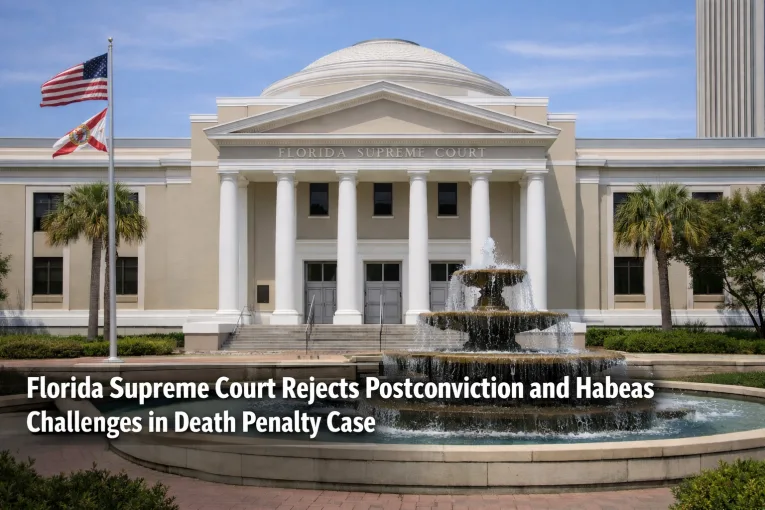
TALLAHASSEE, Fla. — On Dec. 30, the Florida Supreme Court affirmed the denial of postconviction relief and rejected a habeas corpus petition filed by James Terry Colley, Jr., a death row inmate, ruling that his claims of ineffective assistance of counsel and fundamental error failed to justify relief. The court exercised jurisdiction over Colley’s postconviction appeal under Florida Rule of Criminal Procedure 3.851, which challenged the effectiveness of his trial and appellate counsel.
In a per curiam opinion, the court wrote that “for the reasons expressed below, we affirm the denial of postconviction relief and deny Colley’s habeas petition.” The opinion recounts that in 2018, Colley was convicted of “the first-degree murders of his estranged wife, Amanda Colley, and Lindy Dobbins,” along with multiple additional offenses, including burglary and aggravated stalking, and received two death sentences.
The court reiterated that Colley “approached the back of Amanda’s house and began shooting from the outside” before violently entering the residence while shouting, “where is he, where is he.” The opinion states that after encountering resistance at the closet door, Colley “shot and killed” Lindy Dobbins and then proceeded to shoot Amanda Colley multiple times until his firearm was empty, after which he switched weapons and continued firing.
In his postconviction appeal, Colley argued that trial counsel was ineffective for conceding his guilt to second-degree murder, which he claimed violated McCoy v. Louisiana. The court rejected the claim, finding that “McCoy was not violated” because Colley “did not insist that he was innocent of the charged acts; he admitted that he was the shooter.” The court noted that Colley’s disagreement centered on counsel’s “decision to characterize the offenses as second-degree murder rather than manslaughter.”
Applying the Strickland v. Washington standard, the court concluded that Colley’s counsel did not perform below an objectively reasonable standard. The opinion notes that defense counsel told the jury “this isn’t a case of premeditated first-degree murder,” and argued instead that the facts supported “either second-degree [murder] … or even possibly manslaughter.” The court held that “strategic decisions do not constitute ineffective assistance of counsel.”
The court further ruled that Colley failed to establish prejudice, emphasizing that the jury was instructed on multiple lesser offenses yet still convicted him of first-degree murder. According to the opinion, “there is no reasonable probability Colley would have been acquitted of first-degree murder even if counsel had limited the concessions … to manslaughter.”
The court also dismissed Colley’s claim that counsel failed to prepare him to testify, citing the trial court’s confirmation that Colley understood his rights and voluntarily chose not to take the stand. The opinion states that Colley “affirmatively told the court that his decision not to testify was his own,” and concluded that counsel’s recommendation against testifying was reasonable and that Colley “freely and voluntarily waived his right to testify.”
Additionally, the court rejected several other ineffective assistance claims, including allegations that counsel failed to challenge certain witness testimony, labored under conflicts of interest, or failed to present additional mitigation evidence. Addressing Colley’s arguments related to premeditation, the court stated that “evidence of premeditation was already substantial and independent,” and therefore Colley failed to demonstrate prejudice.
The court next addressed Colley’s habeas petition, which raised three claims alleging ineffective assistance of appellate counsel as well as assertions of fundamental error and manifest injustice. Applying the Strickland standard again, the court emphasized that “appellate counsel cannot be deemed ineffective for failing to raise nonmeritorious claims.”
The Florida Supreme Court reaffirmed that the aggravating factors found by the jury and trial court “far outweighed” the mitigation evidence presented by the defense. The court described the murders as “heinous, atrocious, or cruel,” carried out in a “cold, calculated, premeditated manner,” and concluded that Colley’s postconviction claims and habeas petition did not warrant relief, leaving both death sentences intact.
Follow the Vanguard on Social Media – X, Instagram and Facebook. Subscribe the Vanguard News letters. To make a tax-deductible donation, please visit davisvanguard.org/donate or give directly through ActBlue. Your support will ensure that the vital work of the Vanguard continues.
