
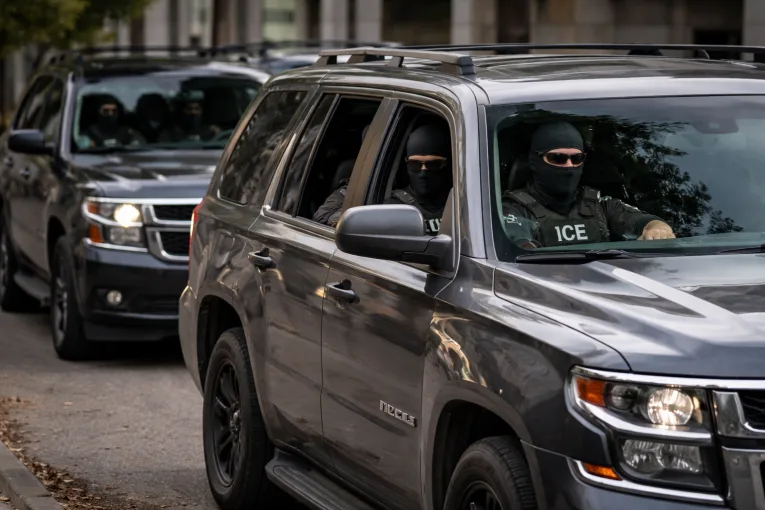
SACRAMENTO, Calif. — State Sen. Scott Wiener and immigration advocates on Wednesday called for new accountability mechanisms for federal law enforcement officers as SB 747, known as the No Kings Act, passed its first legislative test in the California Senate Judiciary Committee, following the fatal shooting of Renee Nicole Goode by an ICE agent in Minnesota.
Speaking ahead of the committee hearing, Wiener, a Democrat from San Francisco, said the legislation is a response to what he described as a growing pattern of federal law enforcement acting without meaningful consequences when constitutional rights are violated. He argued that recent U.S. Supreme Court decisions have effectively eliminated remedies that once allowed individuals to sue federal officers personally.
“So we’re here today because ICE and the Trump administration is trampling over the Constitution and needs to be held accountable,” Wiener said. “The No Kings Act, SB 747, is a nation-leading step to make that accountability possible and to show that no one is above the law.”
Wiener pointed to the Minnesota shooting as a stark example of the problem.
“The ICE agent who shot Renee Nicole Goode in Minneapolis last week in the middle of the street can potentially walk away with no consequences personally,” he said. “That is the state of the law. When you have rights that have effectively no remedies, where you have government actions with no accountability, that is not true democracy.”
Under current federal law, individuals can sue the federal government under the Federal Tort Claims Act, but Wiener said that process is limited and often fails to hold individual officers responsible.
He noted that a once-available pathway to sue federal agents directly, known as the Bivens doctrine, has been “gutted” by the Supreme Court.
“What SB 747 will do is basically replicate what already exists for state and local law enforcement,” Wiener said, referring to Section 1983 civil rights lawsuits. “It will now apply to federal officers as well. This is long overdue.”
Wiener was joined by George Reyes, a U.S. citizen, California resident, and military veteran, who recounted being detained by ICE for 72 hours last year despite not being charged with any crime. Reyes said he was stopped on his way to work and complied with officers’ orders but was still subjected to violence.
“They still trapped me in my car with tear gas. They still broke my window. They still pepper sprayed me,” Reyes said. “They still dragged me out of the car, even though I wasn’t resisting or anything.”
Reyes said two agents knelt on him during the arrest.
“It took two agents, one kneeling on my back, another kneeling on my neck, to detain me even though my hands were already behind my back,” he said. “Even though I was pleading with them, I couldn’t breathe. They still did it.”
He said he was transported to a Navy base, where his DNA was taken, then moved to a detention facility in downtown Los Angeles. Reyes said he was strip-searched, denied access to a lawyer or his family, and placed on suicide watch.
“I didn’t let me call a lawyer. They didn’t let me call my family,” Reyes said. “I was like that for three days and three nights. And I was released that Sunday afternoon. No explanation, no apology, no charges, zero charges.”
Reyes said the experience left him with no sense of closure. “I just got to live with the experience that they put me through with no remedy, no resolution, no answer for anything that happened to me,” he said. “Everyone that’s going through this currently gets no justice.”
State Sen. Susan Rubio, a Democrat from the San Gabriel Valley and a co-author of the bill, said stories like Reyes’ are common in her district and have created widespread fear among immigrant families and even longtime U.S. citizens.
“In an area where ICE raids are a common occurrence, every morning when someone wakes up, they don’t know if they’re going to come home,” Rubio said. “It is unbelievably scary for all our residents.”
Rubio said constitutional protections are meaningless without enforcement mechanisms. “Constitutional rights don’t mean anything if there is no remedy,” she said. “This bill is not anti-law enforcement. This bill is pro-Constitution, pro-accountability, and pro-public trust.”
She referenced the Minnesota shooting directly, saying, “We’ve already crossed that darker line where a mother of three children is no longer with us. Who’s going to tell those poor little young faces that mom’s not coming home?”
Advocacy groups co-sponsoring SB 747 echoed those concerns.
Cristine Soto DeBerry, executive director of Prosecutors Alliance Action, said communities are increasingly facing unchecked federal force.
“Every day, we see federal agents acting with impunity — terrorizing our communities, abducting our neighbors, and assaulting peaceful protestors with dangerous and even deadly force,” DeBerry said. “The No Kings Act affirms a basic principle of our democracy: no one is above the law.”
Hector-Andree Pereyra, policy manager at the Inland Coalition for Immigrant Justice, said states must step in where Congress has failed.
“Californians are depending on their leaders to take immediate action to protect them and provide meaningful pathways for accountability,” Pereyra said. “No one is above the law.”
Senator Wiener framed the legislation as part of California’s broader resistance to what he described as authoritarian behavior by the Trump administration.
“If California can’t stand up to Trump, then who can?” he said. “California has a solemn responsibility to lead and to use every lever of power that we have to protect our residents.”
The No Kings Act applies to constitutional violations that occur in California and is retroactive to March 1, 2025, Wiener said. Supporters acknowledged that the bill is likely to face legal challenges but argued that it is firmly grounded in existing constitutional principles.
SB 747 now advances to the next stage of the legislative process as lawmakers and advocates continue to debate the extent of state authority to hold federal officers accountable for constitutional violations.
Follow the Vanguard on Social Media – X, Instagram and Facebook. Subscribe the Vanguard News letters. To make a tax-deductible donation, please visit davisvanguard.org/donate or give directly through ActBlue. Your support will ensure that the vital work of the Vanguard continues.
