
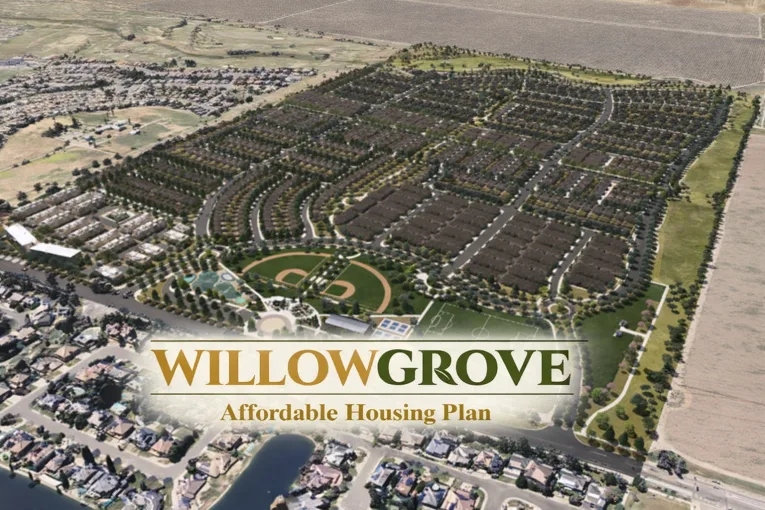
DAVIS, Calif. — The applicants have submitted a revised affordable housing plan for the proposed Willowgrove development that would deliver 250 deed-restricted affordable units, significantly exceeding the city’s minimum requirements while committing to accelerated construction timelines and early infrastructure delivery.
The new draft, dated March 20, 2026 outlines a proposal in which 20 percent of the project’s housing would be reserved for households with extremely low, very low and low incomes, with the total number of affordable units reaching 177 percent of what is required under Davis City Code.
Based on the project’s mix of housing types, city code would require 141 affordable units. The revised plan instead proposes 250 units, a substantial increase that positions the project as exceeding baseline inclusionary housing obligations.
The proposal also includes 288 attached single-family units, such as condominiums and townhomes, intended to provide housing opportunities for workforce households and what planners characterize as the “missing middle.”
A key feature of the revised plan is the commitment to construct all affordable units in a single phase rather than sequencing them over time.
The proposal specifies that the entire affordable housing site would be construction-ready before the issuance of the first market-rate occupancy permit, ensuring that infrastructure for the affordable component is prioritized early in the development process.
The applicants state that the affordable housing component will be included as part of the project’s baseline features, rather than relying on future funding from state or local sources.
The plan points to uncertainty surrounding public funding streams and limited resources in the city’s housing trust fund as justification for structuring the project in this way.
The affordable units will be deed-restricted in perpetuity and rented to households earning no more than 30 percent, 50 percent and 80 percent of area median income, corresponding to extremely low-, very low- and low-income categories.
The plan establishes a target distribution of approximately 30 percent extremely low-income units, 20 percent very low-income units and 50 percent low-income units. It also indicates that the average rent across unit types will be set at or below 65 percent of median income.
At least 30 percent of the affordable units would include three bedrooms, reflecting an emphasis on accommodating families. The document allows for adjustments to the unit mix and income targets based on city needs at the time of final design.
The proposal identifies The Pacific Companies and a nonprofit partner as the developers responsible for constructing and managing the affordable housing component.
According to the plan, The Pacific Companies has completed more than 265 housing developments totaling nearly 20,000 units and currently has more than 5,500 units under construction.
The document states that the company has maintained a 100 percent completion rate over 25 years without a single default, positioning it as an experienced partner capable of delivering a project of this scale.
The revised plan also includes a partnership with Alta California Regional Center to incorporate housing opportunities for individuals with intellectual and developmental disabilities. At least 10 affordable units would be reserved for clients served by the organization and integrated throughout the site.
Alta Regional serves more than 35,000 individuals across a 10-county region, including approximately 2,300 in Yolo County and more than 500 in Davis. The inclusion of dedicated units is framed as part of a broader effort to incorporate inclusivity into the design of the development.
The plan specifies that these units will comply with accessibility standards under the Americans with Disabilities Act and that rents will be set consistent with the affordability restrictions applied to the rest of the project.
In addition to expanding the number of affordable units, the proposal introduces a construction milestone tied to the issuance of market-rate occupancy permits. The plan states that the final 100th market-rate occupancy permit cannot be issued unless construction has commenced on at least 141 affordable units.
Construction is defined as having begun once a financing commitment letter is secured from a qualified lender demonstrating that the affordable housing component is fully funded. This requirement is intended to ensure that affordable housing delivery is not delayed or deferred relative to market-rate construction.
The applicants also commit to delivering a construction-ready site for the affordable housing component prior to the issuance of any production market-rate occupancy permits. The site would include grading, roadway improvements and utility connections, allowing construction to begin as soon as financing is secured.
The document indicates that this sequencing is designed to prioritize infrastructure for the affordable housing site and reduce the risk of delays that have affected other developments. It also provides limited flexibility in the event of unforeseen site conditions or infrastructure constraints, though such adjustments would not alter the requirement to initiate construction on at least 141 units.
The revised plan fulfills affordable housing requirements through on-site construction of rental units located on a designated 10.1-acre parcel identified as the affordable site within the Willowgrove project. This approach is consistent with provisions in Davis City Code that allow developers to meet inclusionary housing obligations through on-site development.
The plan outlines the city’s affordability requirements based on different housing types within the project, including detached single-family homes on large and small lots as well as stacked condominiums. These calculations result in a requirement of 141 affordable units, which the revised plan exceeds by more than 100 units.
The plan also notes that the affordable units will be leased rather than sold, ensuring long-term affordability through deed restrictions that remain in place in perpetuity.
The applicant also provides additional detail on the project’s layout and infrastructure phasing, including how site preparation and backbone improvements would support early construction and ensure the affordable housing component can move forward without delay.
The revised plan includes a single-phase construction approach for all affordable units, along with requirements that infrastructure for the affordable housing site be completed before market-rate occupancy permits are issued and that construction on a portion of the affordable units begin before later market-rate permits are granted.
The proposal will be considered as part of the city’s review of the Willowgrove project, including its consistency with local housing requirements and development standards.
Follow the Vanguard on Social Media – X, Instagram and Facebook. Subscribe the Vanguard News letters. To make a tax-deductible donation, please visit davisvanguard.org/donate or give directly through ActBlue. Your support will ensure that the vital work of the Vanguard continues.

This is (by far) an inferior location compared to Village Farms. Farther from the university, downtown, etc. (but closer to the Mace I-80 on/off ramps).
The Village Farms site will likely (eventually) have some kind of development on it, even if the current proposal fails. Shriner’s (Willowgrove) is less-likely (and in no way can be described as “infill”).
As far as Affordable housing is concerned, there is no money for that at EITHER location. (But truth be told, I don’t understand how Affordable housing makes any difference to an average voter, anyway. Sprawl is sprawl.)
By the way, when will construction begin on the adjacent site (the old horse ranch)?
“This is (by far) an inferior location compared to Village Farms”
I think if you ranked peripheral locations in order of preference, this would be in the top 2 or 3.
Preference of “who”, exactly?
Though in all honesty – I do prefer this site – as continued farmland. There is no way to describe this proposal as anything other than sprawl.
We’ll see what the voters prefer.
When are they going to start building on the adjacent horse ranch? Did they already tear down the existing house?
I heard that the developer of the horse ranch site (Taormino?) agreed to expand the adjacent neighbors’ backyards, in an apparent attempt to quell opposition (which apparently worked).
Look at where the other possible peripheral sites are
You seem to be making an assumption that I don’t make, regarding peripheral farmland outside of city limits.
The only site I see that makes any sense at all is Village Farms, if it didn’t extend beyond The Cannery. (And that’s the only one, and probably the last one ever.) It’s also already in the sphere of influence, I understand.
But even a much-reduced size Village Farms is a LOSS for the existing residents of Davis. Unless people like looking at housing tracts (instead of sunflowers and prime soil) while they’re stuck in newly-created traffic and impediments on the Costco Highway. Also blocking the view of the coastal mountain range and sunsets. How is that an “advantage” to anyone?
But again, when is Taormino going to start developing the horse ranch?
Palomino is already approved so not counting that. The reality of Davis is that they’re only so many spots that you can develop peripherally because most of the south of the city is either UC Davis or in Solano County, which can’t be developed by the city. After that, you should be able to rank order them whether you want them developed or not.
Again, your goal is different than mine, though I believe there are locations near Bretton Woods (which is closer to UCD) for fans of sprawl.
But again, I view Village Farms as the last one ever, and the current proposal will fail. They’re going to have to come back with something more to the liking of folks like McCann, etc.
I don’t know what you mean by “not counting” the horse ranch. Then again, you also don’t seem to count Chiles Ranch, Pole Line Terrace, etc.
Davis is developer-paradise, compared to most communities along the coast. Now, if you want to compare it to Natomas, it’s not “doing so well” in your view I guess. And also not as “well” as Woodland (1,600 more housing units to come at the technology park, in addition to the units still being built in the original part of Spring Lake).
There is no housing shortage. This is among the biggest fibs ever told. And so far, even the 1,600 housing units are apparently not penciling out. (Probably because the city is still insisting that there’s at least “some” commercial development at that site.) I understand that it was formerly commercial-only (and we know how that works out).
I’m not talking about goals at this time, just talking about rank-order potential peripheral sites.
David, why can’t Solano County land be annexed? Yolo County land can. Is there any reason why Solano County couldn’t come to a tax sharing agreement with the City the same way Yolo County can? After all there is a restaurant/bar in New England that resides half in the US and half in Canada. If that can be worked out, an annexation from Solano County should be a piece of cake.
California law requires that any territory annexed to a city be in the same county, therefore, a city’s jurisdiction cannot extend across county lines.
A city may annex territory “located in the same county as that in which the city is situated.”
Ron O
We already know that you don’t understand housing economics and that an elevated price premium is the prime indicator that there is housing scarcity. You’re just about the only person who believes that there is not a housing shortage–you’re as credible as a Flat Earther.
Richard: If you don’t understand that there’s price differentials between cities, and even within the same city (and that there always have been), I’m not sure I can help you. Are you sure that you’re a “professional economist” as you claim?
You seem to be stating that unless housing prices are based on some comparable lowest price (e.g., in Detroit?) – then there’s a housing shortage for that locale.
Maybe you have this backwards. How about if you compare local housing prices to the “highest price” locale as a baseline, and work backwards to see where the “glut” of housing is.
Start with Tiburon and Atherton, and work your way down to see where the “glut” is. Pretty sure that Davis will pop up on the list of “oversupply” using that metric.
Also, prices are dropping in most locales. When are they going to start tearing down houses, as a result (in regard to your metric)?
“California law requires that any territory annexed to a city be in the same county, therefore, a city’s jurisdiction cannot extend across county lines.”
The only way for Davis to annex property currently in Solano County would be a county boundary change between Yolo and Solano county. That would require approval of both boards of Supervisors and LAFCOs and possibly an election. To accomplish this would likely mean some sort of tax revenue sharing plan between the counties (and their intended use by a city).
“The plan states that the final 100th market-rate occupancy permit cannot be issued unless construction has commenced on at least 141 affordable units.”
How is this any different than what is proposed at Village Farms? – Except it seems WillowGrove is not providing the multi-million dollar additional juice to help finance construction.
I’m sure the naysayers will jump all over this about the supposed inadequacy just like they did with Village Farms…eh?
It seems the obvious difference is the actual commitment to building affordable units and the up-front timeline. Alan, you have been asked: where is the written commitment from Village Farms to build affordable homes. I have not seen your answer. A possible ‘request’ seems like “supposed inadequacy”; NOT this development’s commitment.
“Except it seems WillowGrove is not providing the multi-million dollar additional juice to help finance construction.”
What is multi-million dollar additional juice?
Alan P is referencing the $6 million that the VF developer is contributing toward the Affordable housing component. Of course, most of that money will go towards the administrative costs because that amount might construct only a dozen units.
This passage seems to be the key difference between WG and VF:
“The proposal specifies that the entire affordable housing site would be construction-ready before the issuance of the first market-rate occupancy permit, ensuring that infrastructure for the affordable component is prioritized early in the development process.
The applicants state that the affordable housing component will be included as part of the project’s baseline features, rather than relying on future funding from state or local sources. “
I learned something very interesting in the last few days that gave me an incredible sense of “Here we go again!” Specifically, where is the $6 million coming from. Alan Pryor has said above that the $6 million is coming from the developer, but is it? Or is it coming from the taxpayers? The history of the Cannery tells us that there is a very good chance that the taxpayers will end up footing the bill for the $6 million. But because Village Farms is so sketchily defined/described, there is no way to know.
Cannery was much better and more completely described/defined, but one year after the documents had all been signed, they came back to the City saying they “needed” $12 million more cash. City Council negotiated the $12 million down to $8 million … and then imposed a 30-year Mello-Roos Tax on the Cannery residents, the taxpayer total payments of which amounted to more than $21 million taken out of those taxpayers’ pockets.
There is nothing in the Baseline Features or the Development Agreement that tells Davis voters whether there will be a Mellow-Roos levy (often called a CFD), or and/or how large the Mellow-Roos levy will be.
To add insult to injury at The Cannery, the City Council never asked the developer what value the City was getting back for the $12 million being asked for, or the $8 million eventually given. Unfortunately, the City got zero dollars of value in that Cannery situation. We have no way of knowing what might happen in the case over Village Farms.
I’m not exactly sure “who” takes responsibility for CFDs/Mello Roos that fall short when a housing crash occurs, but I do know that something like this occurred during the housing crash of 2008-2011 in Spring Lake (and probably elsewhere).
Most construction unexpectedly stopped during that period, but there were still CFD/Mello Roos bond payments that had to be made (to support infrastructure that was suddenly “oversized” compared to the unexpectedly few houses that were built).
Pretty sure that the CFD/Mello Roos Ponzi scheme almost collapsed during that period. I do recall some concern from the city regarding all of that mess.
In any case, you can be almost certain that any new development outside of a current city is going to include CFDs/Mello Roos (often times, more than one). This is true everywhere in California.
This is one of the reasons that pre-existing housing is generally a much better deal for buyers. (Little or no Mello Roos.)
I don’t think that non-homeowners, or those who purchased their homes a long time ago (or in an established neighborhood are that aware of this ongoing cost – which can also increase every year.
Really? Seriously? Is anyone disputing this?
Because if what MW just said is true, I’m never voting for anything ever again.