
WASHINGTON — Immigration and Customs Enforcement detention centers are facing renewed scrutiny after Solitary Watch reported cases in which detainees with serious medical needs or suicidal thoughts were allegedly placed in solitary confinement instead of receiving proper care.
Solitary Watch reported that, in an article co-published with The Nation, Francisco Rodriguez examined “the increased use of solitary confinement in Immigration and Customs Enforcement (ICE) detention centers under the Trump administration.”
Rodriguez wrote, “The spike in solitary confinement epitomizes the abuses of a migrant detention system that seems to be spinning out of control,” adding that the number of detained and isolated people has “more than doubled,” while “abuses and deaths in detention” are “also exploding.”
The article highlighted the case of Angel Lemus-Linares, “a 32-year-old migrant from El Salvador,” and described “the abuse he experienced from ICE agents while in prolonged, unjustified solitary.”
Solitary Watch also noted that its updated fact sheet, titled “Solitary Confinement in Immigrant Detention,” stated that “though ICE has employed solitary for years, its use has skyrocketed under the second Trump administration.”
Solitary Watch’s fact sheet connected the issue to broader detention practices, noting that solitary confinement appears across “U.S. prisons, jails, and immigrant and juvenile facilities.”
The roundup also emphasized that the fact sheet included “facts, analysis, and resources” on solitary confinement in immigrant detention, placing the reported ICE cases within a wider pattern of concern over isolation in confinement settings.
One case involved Denny Adan Gonzalez, who was found unresponsive in his solitary cell. According to the report, “It took 20 minutes for an ambulance to arrive and administer life-saving efforts” after Gonzalez was found.
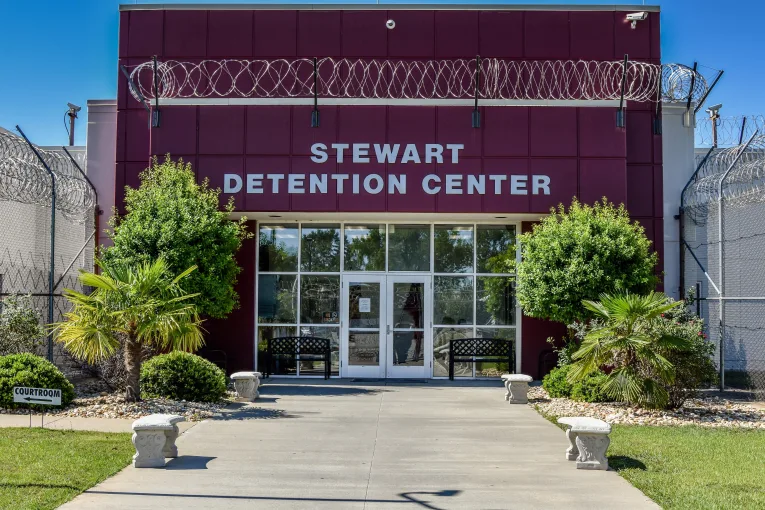
The report also stated that when an ICE detention guard called 911, “it took over two minutes for the operator to even grasp that Gonzalez had attempted suicide.” A firefighter eventually drove “his own personal vehicle” to the Stewart Detention Center, where Gonzalez was pronounced dead.
Dr. Amy Zeidan, described as “an immigration detention health care researcher,” said, “In certain situations, like a cardiac arrest or stroke, the first 10 minutes is critical.”
Solitary Watch stated that Gonzalez’s case reflected “a common pattern across other deaths in ICE custody,” with similar situations reported in 2023 and 2024.
Another case involved Xiaoman Ding, who “suffered from a diagnosed brain tumor that caused terrible headaches” while detained at the Adelanto ICE Processing Center in California.
According to the report, Ding asked for medical treatment but “was given Tylenol and ibuprofen.” After she said her pain was “so unbearable that she wanted to take her own life,” Ding “was placed in solitary confinement instead of receiving assistance.”
Ding’s story was included in “a private lawsuit filed in January aimed at improving conditions in the detention center,” where detainees allegedly faced inadequate medical and mental health responses.
The report also described the case of Sana Atou, who was deported after speaking with two U.S. congresswomen about conditions at an immigrant detention center in Michigan. Atou reportedly told them he had been isolated for weeks in a room “so cold he couldn’t feel his toes” and that “his guards were throwing his food into the cell.”
ICE stated Atou’s deportation had been scheduled “well in advance” of the congressional visit. However, Atou’s lawyer said he believed “it was retaliation for him talking to the Congresspeople,” especially because “his [case] was still pending.”
The reported cases raise concerns that solitary confinement in ICE detention is being used as punishment or control even in situations involving medical distress, mental health crises, and detainees who speak out about detention conditions.
Follow the Vanguard on Social Media – X, Instagram and Facebook. Subscribe the Vanguard News letters. To make a tax-deductible donation, please visit davisvanguard.org/donate or give directly through ActBlue. Your support will ensure that the vital work of the Vanguard continues.
