
On Tuesday, the Yolo County Board of Supervisors will give direction on which path they want to take to replace longtime District Attorney Jeff Reisig.
Chief Deputy District Attorney Melinda Aiello is currently serving as acting district attorney while the Board considers how to appoint a successor for the remainder of the unexpired term, which runs through Jan. 8, 2029.
County staff explained in a background memorandum that, under state law and a formal opinion issued by the California Attorney General, the Board of Supervisors is responsible for appointing a replacement rather than calling a special election.
The county memorandum states that eligible candidates “must be registered voters of Yolo County at the time of appointment and hold an active license with the California State Bar.”
The report further notes that Government Code section 25304 “dictates that an appointment for the remainder of the term must be made by the Board, and it does not authorize the position to instead be filled by a special election.”
The staff report suggests two paths. Supervisors could appoint Aiello to permanently fill the role for the remainder of the term.
According to the staff report, “This approach would support continuity of leadership, minimize operational disruption within the Office of the District Attorney, and allow for an expedited appointment given the essential functions of the office and the ongoing prosecution workload.”
The Board could also choose to conduct what county officials described as an abbreviated recruitment process.
Under that approach, supervisors could direct staff to develop procedures for a competitive selection process that would permit additional candidates to apply for the position.
The county report states, “This type of recruitment process would require additional time, staff resources, and would extend the period without a permanent District Attorney, but would also provide the opportunity for other candidates to be considered.”
Which way will the Board go? It seems likely that the Board will go with Aiello. “Continuity” appears to be preferable, and at least one board member suggested to me that it would be better if change came from the voters rather than by appointment.
A bigger question is whether continuity is actually desirable. The DA’s office has made a number of questionable decisions over the years, along with some grievous mistakes.
Three recent cases stand out.
One was the decision by the DA’s office to charge UC Davis protesters with felony conspiracy to commit a misdemeanor. Judge Sonia Cortes eventually threw out the charges in the interest of justice after UC Davis agreed to a restorative process that included restitution.
Then there was the decision to charge Marissa Barrera, an activist and podcaster whose brother was killed by Woodland police, with criminal threats against one of the officers.
Judge Catherine Hohenwarter granted the defense motion to dismiss after reviewing a YouTube video posted by Barrera in December 2024 and hearing extensive argument focused on whether her speech could lawfully be treated as incitement or electronic harassment.
“I cannot get past the language of the statute,” Hohenwarter said in ruling from the bench. “There was no speech identified by the People that would qualify for those qualifications included in the statute.”
There are also the fraud charges against Yuba Community College District Trustee Jose L. Garcia, a case that remains ongoing nearly three months after the initial preliminary hearing, where the defense raised questions about the relationship between DA investigator Brett Hancock and one of the complaining witnesses.
The defense argued that the case largely hinges on Hancock’s investigation and interpretation of financial transactions involving the trust and family finances.
During cross-examination on March 6, defense attorney Ron Johnson questioned Hancock extensively about his communications and relationship with two of Jose Garcia’s sisters, Mini Garcia and Lucy Garcia, both daughters of Gloria Garcia.
That case remains ongoing.
Two high-profile cases remain particularly problematic for the current DA’s office.
The DA’s office has faced sharp criticism for its handling of the serial stabbing case in Davis, where nearly three years ago Carlos Dominguez stabbed and killed two people and severely injured a third.
But the DA’s office misplayed the case almost from the start. Prosecutors attempted to challenge multiple mental health evaluations that found Dominguez incompetent to stand trial, attempted to use a jury proceeding to overrule those findings, and then ultimately conceded that Dominguez was not competent to stand trial — something many observers believed was evident from his near-catatonic condition in court.
When the case eventually went to trial, Dominguez was acquitted on first- and second-degree murder charges and nearly walked on manslaughter charges as the jury reportedly split 10-2 for acquittal.
In a hearing a few weeks ago, Judge Sam McAdam questioned whether prosecutors appreciated how close the previous trial came to acquittal, noting that Dominguez had been “2 votes from walking out of the courtroom in the last trial.”
Deputy DA Matt DeMoura responded that if jurors in the first trial had received instructions on involuntary manslaughter, all 12 jurors would have voted to convict because of what he described as substantial evidence.
Judge McAdam countered that substantial evidence also supported second-degree murder and emphasized that prosecutors must still prove implied malice beyond a reasonable doubt.
Multiple evaluations and courtroom observations strongly suggest that Dominguez suffers from schizophrenia, but the DA’s office continues to pursue a controversial theory centered on marijuana-induced psychosis.
This is not the only high-profile case that has raised questions in recent years.
A few years ago, Justin Gonzalez had his murder conviction overturned because of changes in state law, and despite repeated questioning from Judge McAdam directed at Deputy DA Robin Johnson, the case still proceeded to trial and ended in a swift acquittal.
There are also questions being raised about the timing of Reisig’s retirement, which came shortly after the release of the Grand Jury report and the announcement of indictments connected to the Esparto fireworks explosion.
The July 2025 explosion occurred on property owned by then-Yolo County Sheriff’s Lt. Samuel Machado and his wife. Investigators later alleged the site housed a massive illegal fireworks operation that county officials had known about for years.
These are just some of the recent controversies surrounding the DA’s office.
Meanwhile, Melinda Aiello has emerged as a key figure in what the Vanguard has characterized as Reisig’s hard-right turn on criminal justice issues.
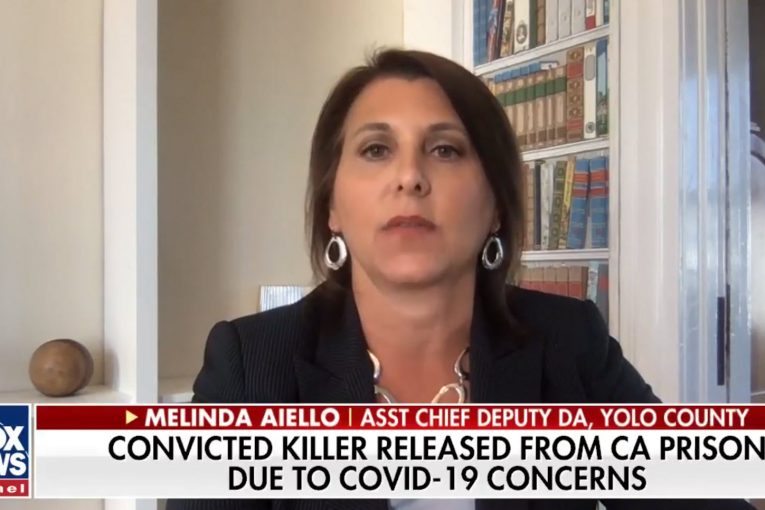
Aiello became one of the office’s leading public voices attacking zero bail and reform-oriented policies, including appearances on Fox News. At the same time, Reisig increasingly aligned himself with conservative media outlets such as Fox News, Newsmax and City Journal while denouncing progressive prosecutors and criminal justice reform.
Aiello herself was involved in one of the most striking prosecutorial failures in Yolo County in recent years.
In 2017, Deputy District Attorney Melinda Aiello prosecuted Lance Ornellas-Castro for first-degree murder under the felony murder rule in the shooting death of Andrew Phaouthoum during what prosecutors alleged was a marijuana robbery.
The prosecution pursued an aggressive theory that Ornellas-Castro and co-defendant Jorge Garcia had planned to rob the victim and executed him during the commission of that felony. Aiello argued to jurors, “This was an execution.”
But the prosecution’s case began to unravel during trial as defense attorneys attacked the credibility of key witnesses, including cooperating witness Jorge Garcia and portions of the sheriff’s investigation.
The defense argued there had been no robbery conspiracy and that Ornellas-Castro acted in self-defense or imperfect self-defense after believing the victim was reaching for a weapon.
According to Vanguard coverage at the time, jurors quickly acquitted Ornellas-Castro not only on first- and second-degree murder charges, but also on attempted robbery and conspiracy counts, before ultimately acquitting him outright on all charges.
The acquittal was widely viewed as a stunning rebuke to the prosecution’s theory of the case. The Vanguard later described the outcome as a major embarrassment for the DA’s office, noting that the jury appeared deeply troubled by inconsistencies and dishonesty among prosecution witnesses, including law enforcement testimony.
Ultimately, we suspect that the Board of Supervisors will opt for “continuity” rather than systemic change.
But Yolo County residents may want to ask whether this is truly the type of continuity the county needs.
Follow the Vanguard on Social Media – X, Instagram and Facebook. Subscribe the Vanguard News letters. To make a tax-deductible donation, please visit davisvanguard.org/donate or give directly through ActBlue. Your support will ensure that the vital work of the Vanguard continues.

The broader question for the Supervisors is whether the strategy that Reisig pursued was cost-effective. My data is a bit stale but still illustrative. When he came to office he chose to increase the number of cases that went to trial without settling. Yolo soon went to the highest number of trials per capita in the state, even far exceeding Kern, the next highest county. The crime rate took a one-year dip but then tracked with the rest of the state. In other words, the increased trial rate had little to no discernable impact on the crime rate in Yolo County. But going to trial is very expensive, costing the County millions of dollars more than other counties that settle much more often but have similar trends in crime rates. If the County wants to save money with a tight budget, the Supervisors should choose a DA who is much more willing to reach settlements rather than pursuing showmanship.