
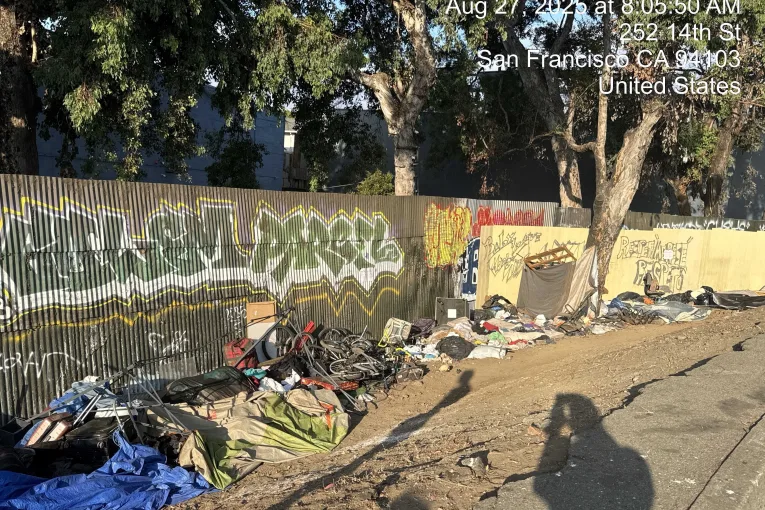
- “No one should live in a dangerous or unsanitary encampment, and we will continue our ongoing work to ensure that everyone has a safe place to call home.” – Gov. Gavin Newsom
by Vanguard Staff
SACRAMENTO — Gov. Gavin Newsom on Thursday announced the creation of a new statewide task force to dismantle homeless encampments and expand access to shelter and supportive services, building on his administration’s years-long strategy to address California’s homelessness crisis.
The initiative, called the State Action for Facilitation on Encampments (SAFE) Task Force, will coordinate state agencies to remove encampments from state rights-of-way in California’s ten largest cities, including Los Angeles, San Francisco, Oakland, San Diego, Sacramento, San Jose, Long Beach, Anaheim, Bakersfield and Fresno. Newsom said the task force would deploy emergency management, housing, health, and public safety resources in partnership with local governments.
“California has put in place a strong, comprehensive strategy for fighting the national homelessness and housing crises — and is outperforming the nation as a result in turning this issue around,” Newsom said in a statement. “No one should live in a dangerous or unsanitary encampment, and we will continue our ongoing work to ensure that everyone has a safe place to call home. Today I am establishing a new task force that pairs urgency with dignity — restoring safe, usable public spaces while providing care for Californians living in dangerous encampments.” Source
The announcement follows the governor’s 2024 executive order directing state and local governments to clear encampments using a model that offers housing, notice, and support. That directive came shortly after the U.S. Supreme Court issued a ruling that eased legal barriers for removing encampments, allowing state and local officials to clear sites with fewer restrictions. Newsom also filed an amicus brief urging the Court to give governments greater authority to address encampments, citing public health and safety concerns.
The SAFE Task Force is designed to centralize the state’s tools and programs for encampment clearance and service delivery. It includes the Office of Emergency Services, which will manage logistics and resource deployment; the Business, Consumer Services and Housing Agency, which oversees housing and homeless grant funding through the Department of Housing and Community Development; the Interagency Council on Homelessness, which will provide guidance and coordinate outreach; the Health and Human Services Agency, which will support health and behavioral health programs, including substance use treatment; the California Highway Patrol, which will provide public safety during operations; and the State Transportation Agency, which will oversee clearance of encampments on rights-of-way.
Caltrans, part of the transportation agency, has played a major role in encampment removal. Since July 2021, it has cleared more than 18,000 encampments along state rights-of-way and collected more than 334,000 cubic yards of debris, equivalent to nearly 12,000 garbage trucks of waste. State officials said Caltrans will continue this work as part of the new task force, but now with additional coordination from other state agencies and local partners.
Recent agreements with San Francisco and San Diego highlight how the state plans to partner with cities. In San Francisco, Caltrans signed a Delegated Maintenance Agreement to streamline cleanup efforts on state property. In the first two days of the agreement, Caltrans and city crews cleared encampments at Cesar Chavez Junction and at 13th and Van Ness, connected 12 people with services and shelter, and removed about 90 cubic yards of debris. Since July 2024, Caltrans has removed 81 encampments in San Francisco, a 58 percent increase from the prior year. A similar agreement with San Diego was reached earlier this summer.
Officials said the SAFE Task Force will launch operations within the next 30 days, focusing on the largest and most unsafe encampments in urban centers. The task force will work in what the governor’s office described as a “unified way across state government” to both clear encampments and expand access to housing, mental health treatment, and substance use support. The administration emphasized that the coordinated approach is intended to prevent cleared sites from being repopulated, a recurring challenge in many cities.
The task force is one piece of a larger homelessness and housing strategy Newsom has pursued since taking office. His administration has invested billions of dollars in shelter beds, permanent supportive housing, behavioral health treatment, and programs targeting veterans, youth, and families. Voter-approved Proposition 1 expanded funding for mental health and housing programs, while a new CARE Court system is intended to create legal pathways for treatment of individuals with severe mental illness. Updated conservatorship laws are also designed to address the overlap between mental health conditions and homelessness.
State officials pointed to data showing progress in several regions. According to the governor’s office, Los Angeles County saw a 9.5 percent decline in unsheltered homelessness, while the city of Los Angeles saw a 7.9 percent decline. San Diego County reported a 6.6 percent drop overall, including a 13.5 percent reduction in the city of San Diego. Other areas reported even sharper decreases: Riverside County reduced unsheltered homelessness by 19 percent, San Bernardino County by 14.2 percent, Sonoma County by 22.6 percent, Contra Costa County by 25.5 percent, and Santa Cruz by 20.4 percent. Kings County reported a 26.7 percent reduction, the steepest in the state. Ventura, Tulare, and Kern counties also reported decreases.
These reductions, state officials argued, show California bucking the national trend. Between 2014 and 2019, before Newsom took office, unsheltered homelessness in California rose by an estimated 37,000 people. Since then, the administration says, growth has slowed significantly. In 2024, homelessness increased nationwide by more than 18 percent, while California limited its overall increase to 3 percent. The state also held unsheltered growth to less than half a percent, compared to a nearly 7 percent increase nationally. Florida, Texas, New York and Illinois all reported higher increases in both total and unsheltered homelessness. California also reported the largest reduction in veteran homelessness and progress in reducing youth homelessness.
The governor has also emphasized holding local governments accountable for addressing homelessness. His administration has tied billions in funding to measurable outcomes, including reductions in encampments and increases in housing placements. At the same time, he has pressed cities and counties to speed up permitting, expand shelter, and engage in encampment clearances using the state’s model. “We have set clear expectations for local governments to address encampments in their communities and connect people with housing and support,” Newsom said in earlier remarks tied to his encampment directive.
Advocates for unhoused people have often criticized large-scale encampment removals, arguing that they disrupt fragile support networks and put people at risk when shelter space is limited. Newsom’s office counters that the state’s strategy pairs encampment clearance with housing, services, and advance notice. The administration said its approach is intended to be both humane and effective, contrasting it with what it called the “haphazard strategies” of the Trump administration, which it said focused more on removals without providing adequate services.
The SAFE Task Force represents an effort to consolidate the many elements of California’s approach into a coordinated unit. State officials said the task force will ensure that local governments have the support they need to carry out encampment clearances while expanding housing and care options. The administration described the effort as structural and foundational, intended to have “positive impacts for generations to come” by addressing not just the symptoms of homelessness but also its underlying causes.
With new encampment operations set to begin within a month, state officials said the first sites will be chosen based on visibility, safety concerns, and the availability of housing and services for those being relocated. The governor’s office framed the task force as a way to “pair urgency with dignity” in dealing with one of California’s most pressing issues.
Follow the Vanguard on Social Media – X, Instagram and Facebook. Subscribe the Vanguard News letters. To make a tax-deductible donation, please visit davisvanguard.org/donate or give directly through ActBlue. Your support will ensure that the vital work of the Vanguard continues.
