
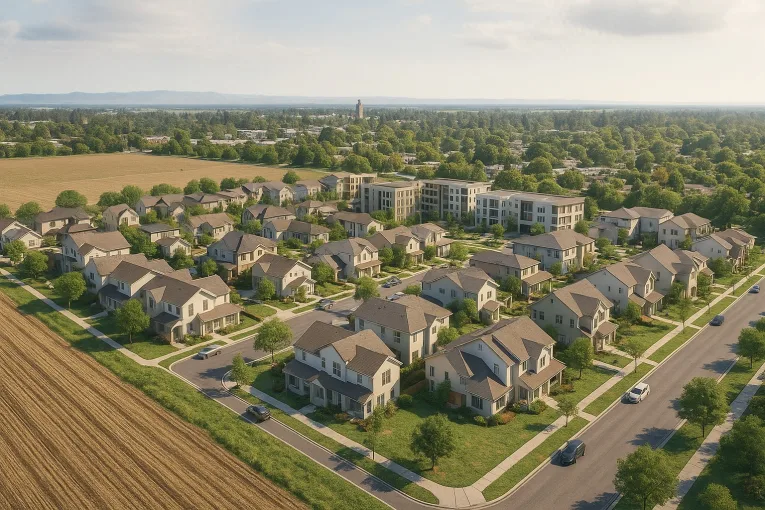
- “The city is running out of land to build on within its borders, and the state is growing impatient.” – Davis faces mounting pressure from the California Department of Housing and Community Development (HCD) to demonstrate progress on housing production or face state intervention.
In 2020, Davis voters renewed Measure J by an overwhelming 83–17 margin, reaffirming the city’s two-decade experiment in direct democracy over housing. Supporters point to that number as proof that Davis residents are overwhelmingly satisfied with the system.
But numbers can mislead.
The context behind that 83 percent margin — the lack of organized opposition, the limited nature of the ballot question, and the worsening housing crisis since — reveals a far more complicated picture.
Five years later, the landscape has shifted dramatically. The city is running out of land to build on within its borders, and the state is growing impatient.
Davis faces mounting pressure from the California Department of Housing and Community Development (HCD) to demonstrate progress on housing production or face state intervention.
As HCD warned in a recent notice to SACOG: “This communication serves as a notice to SACOG that HCD will be reviewing housing element program implementation in the upcoming weeks.”
The department added, “Upon a preliminary review of the annual progress report, HCD will reach out to jurisdictions to gain a stronger understanding of progress, then will internally determine next steps based on the conditions and circumstances.”
That bureaucratic language masks a clear message: the state is watching — and Davis is on notice.
This is not a new warning.
In 2021, HCD explicitly stated that Measure J “poses a constraint to the development of housing by requiring voter approval of any land use designation change.” The city countered at the time that it had sufficient infill sites to meet its housing obligations through 2029.
But even city officials have since acknowledged that this strategy won’t hold.
In December 2023, then-Mayor Will Arnold cautioned that meeting the next RHNA cycle through infill alone would be nearly impossible, noting the “difficulty we’re having in doing so” even for the current allocation.
Legal Services of Northern California went further, calling the city’s earlier conclusion “false.” In a letter to the city, the organization argued that Measure J delays and added costs inherently limit housing supply — even when sufficient infill sites exist on paper.
“The City Council’s recent decision to not put any of the five peripheral development proposals on the ballot for November 2024 proves that Measure J/R/D does limit housing supply,” the letter stated.
While that’s a more aggressive reading of the law than the city has adopted, it reflects the broader reality that Davis cannot rely indefinitely on infill alone.
Under Government Code section 65583(a)(5), cities are required to identify and remove governmental constraints — including land use controls — that hinder the ability to meet regional housing needs. Measure J, by requiring a public vote on nearly all peripheral growth, fits squarely within that definition.
City staff may not have said it directly in their latest report, but the implication was clear.
The city is worried. It is struggling to meet existing housing requirements, let alone what’s coming in the seventh-cycle Regional Housing Needs Allocation.
The city’s decision to reopen the Measure J discussion so soon after its last review is a clear acknowledgment that it sees the writing on the wall.
The “constraint” argument may have been deferred in the last Housing Element cycle, but it won’t be ignored in the next one.
Once again, the city is exploring whether to modify Measure J in a way that preserves local control while loosening restrictions enough to actually allow the city to meet state mandates.
Yet supporters of the status quo have seized on the 83 percent figure as a shield. “The voters spoke clearly,” they argue, suggesting that any attempt to amend Measure J would defy the popular will. The problem with that argument is that it treats a procedural renewal vote as a broad endorsement of permanent growth control.
First, the 2020 renewal was uncontested. There was no organized opposition, no public campaign to make the case for reform, and virtually no public debate. Voters were offered a binary choice: keep Measure J or eliminate it entirely. That’s not a conversation — that’s a litmus test.
Second, the context has changed. Since 2020, the city’s housing crisis has only worsened. The cost of living has continued to rise, the number of available units has dwindled, and even the most modest infill projects face mounting resistance or physical limitations. Students, working families, and seniors have been squeezed out of the local market. The idea that the same electorate, if presented with a well-crafted middle ground, would automatically reject any reform seems far from certain.
Third, the voters have never been given that middle ground. Since Measure J’s adoption in 2000, every renewal has been all or nothing — extend it or lose it. What Davis has never had is a genuine community dialogue about what a modernized version of Measure J could look like — one that maintains public input while meeting the reality of 2025 housing law.
In the short term, Davis might still meet its Sixth Cycle RHNA numbers through rezonings and infill adjustments — although given what is transpiring that seems to at least be in some doubt.
But the long-term question is whether the city can continue to defend a policy framework that the state now views as exclusionary and obstructive to housing production.
The irony here is striking. The measure that was designed to give Davis voters control over growth may, if left untouched, invite Sacramento to take that control away.
For years, Davis has treated Measure J as sacred — the cornerstone of its identity as a slow-growth community that values deliberation and consensus. And in many ways, that ethos has served the city well. It has preserved open space, controlled sprawl, and ensured that new development is subjected to robust public scrutiny. But it has also created paralysis.
Projects like Nishi, DISC, and Palomino Place illustrate just how difficult it has become to secure voter approval for any housing on the city’s periphery. Even well-planned projects with strong environmental standards and affordable components have failed at the ballot box. Each defeat reinforces the belief among developers that trying again simply isn’t worth it.
That chilling effect extends beyond developers. Regional planners, state housing officials, and even university administrators now view Davis as a bottleneck — a city whose restrictive policies contribute to the region’s broader housing shortage.
If Davis wants to preserve any semblance of self-determination, it must move first.
That means initiating a real, inclusive conversation about Measure J’s future — not whether it should exist, but how it can evolve. That conversation should consider options like partial exemptions for high-affordability projects, periodic growth boundaries that coincide with RHNA cycles, or streamlined approval processes for developments that meet sustainability and affordability benchmarks.
It’s time to abandon the illusion that 83 percent support in 2020 equals a mandate for inaction in 2025. Public sentiment is not frozen in time. If anything, the deepening housing crisis may have shifted opinions toward pragmatism — especially among younger voters who have been priced out of the community.
In the end, the question facing Davis is not whether it values open space or community control. It’s whether those values can coexist with fairness, inclusion, and legal compliance in the current housing landscape.
Measure J’s defenders will continue to invoke that 83 percent number. But numbers don’t tell stories — people do. And the story of Davis today is not one of contentment but of constraint. The challenge now is whether the city can write a new chapter before someone else writes it for them.

Measure J —-> 83% approval to only 17% against.
You hardly ever see election landslides any bigger than that.
The last two renewal cycles have been a lot like Russian elections–no real alternative offered. Of course after the housing frenzy of the 1990s, citizens wanted a say. But there’s more than one way to offer good choices. And providing much more upfront guidance to developers means that we are much more likely to get good projects proposed rather than the haphazard lowest common denominator ones that we are offered now. Those who oppose modifying Measure J/R/D are simply no growthers with their heads in the sand. We’ll lose all control if we don’t accept that there are better alternatives.
As we stated in our article a little while back… the only thing worse than measure J is no measure J
https://davisvanguard.org/2025/05/measure-j-and-sprawling-development/
When you have a choice between measure J and unchecked sprawl, measure J is a clear winner. Im extremely critical of measure J but even i agree with that.
What we have lacked is a realistic counter-proposal, something that offereed a different better path.
In the absense of a better idea… extengind J was the right call, and the citizins agreed.
The doesnt mean that if you had a better idea on the plate the result might be different.
You left out that renewal came up for a vote during the pandemic which is why there was no formal opposition.
“Since 2020, the city’s housing crisis has only worsened.”
Demonstrably false. Because both Davis and UC built lots of apartments the housing vacancy rate is up and rents at the lower end have stabilized. The problem is that we haven’t built enough to meet the needs of the community. The answer is simple build more.
That part of the housing crisis improved, but overall for family housing and affordability and availability of for sale housing, no
“availability of for sale housing, no”
WHATTTTTT?
I know several realtors in this town. The say there is a huge number of houses for sale — and price reductions are commonplace, sometimes more than one price reduction on the same house.
LOL, I love how the verbiage has changed on the Vanguard regarding the Urban Limit Line .
It stated as “In addition, commissioners will discuss the idea of creating an urban limit line, a planning tool that would establish boundaries beyond which the city cannot expand.”
Then went to “A genuine Urban Limit Line would create a fixed boundary for development that’s revisited every eight years to coincide with the state’s Regional Housing Needs Allocation (RHNA) cycle.”
And now “periodic growth boundaries that coincide with RHNA cycles”
What, not so “genuine” anymore?
A question for the Vanguard readers:
When is a limit line not a limit line?
From article: “The context behind that 83 percent margin — the lack of organized opposition, . . .”
There was barely an organized campaign in SUPPORT of Measure J last time.
Just wait until THIS time.
But the good news is that attempting to dismantle Measure J now will doom both of the current Measure J proposals.
But those attempting to dismantle Measure J would be better-served if they at least put forth honest arguments – none of which can be found here. Perhaps they think the only way they can win is by lying.
You have to laugh Ron, it only passed by such a wide margin because of Covid and no organized opposition but Covid didn’t seem to stop people from voting for it.
Key question I raised in this piece: is there a middle ground between the current status quo and the state coming in to eliminate Measure J that would be acceptable to the majority of the voters?
That “choice” as presented is the primary lie. The state is not targeting Measure J – per your own citations.
The only people targeting Measure J are those who are opposed to it REGARDLESS of the state’s position. They are a dishonest bunch, and are attempting to mislead voters by referring to the state.
This is partly how politics gets “personal” in nature – going beyond the issue itself.
“But numbers don’t tell stories — people do.”
I will remember to use that line against you every time you use a ‘statistic’. From now until the end of time forever and ever.
Seriously. When the Vanguard is involved it seems that often the only polls or statistics that count or can be relied on are those that back the Vanguard’s agenda.
Funny how that works…
Eighty-three percent voted for a straight renewal. That is a fact so I really don’t know what David is saying. But, I’ll say this, I was part of that 17%, and one of my arguments was that a 10 year renewal was too long. So, here we are 5 years later, and, I think its fair to say that the political ground has shifted and more people have come to understand that after 25 years Measure J needs reform.
Sadly, there are two problems with taking this up now. Firstly, proposed amendments might effect the political calculus of the upcoming measure J votes. Secondly, Measure J must be renewed in 2030. At that point the city Council can make whatever changes they want while doing it mid-term requires an affirmative vote. Doing it now gives the behavioral advantage to an amendment failing.
If people had listened to me about not doing a 10 year renewal in 2020 amending Measure J now would be an easier political lift. C’est la vie.
I agree with some of what you say here, except that David has been attacking Measure J for the past 10 years that I’ve been reading the Vanguard (since 2015). The only difference is that he’s finally acknowledged doing so, more recently (maybe 5 years ago).
This is also the reason that you’re correct regarding David’s “conflicting messages”.
At least everyone knows where you stand.
I have suggested modifications to Measure J, that’s hardly an attack.
What you’re advocating for is a dismantling of Measure J, with no relationship to it.
That’s o.k. in a sense – if you’re honest about it like Ron G. is. (This is why he challenged you so often regarding your position.)
In this case, Ron G. suggests waiting for political reasons, which is also (probably) correct in regard to any chance of success. (And yet, you’ve given him a “hard time” in the past, regarding his position regarding chance for success.)
Personally, I think there is no chance to dismantle Measure J now, or in 5 years from now. But Ron G. is probably right that the chances are better when it comes up for renewal.
Except I’m not suggesting dismantling Measure J, I want a midway policy between the status quo and no Measure J.
And this is where Alan M (who is not a supporter of Measure J) is correct. There is no “middle ground”.
The reason there is no middle ground is that every other proposal will have glaring faults/weaknesses.
Woodland has a voter-approved “urban limit line”. Would you care to hear my thoughts on that (regarding “where” it was drawn)?
That has nothing to do with middle ground…
Yeah, but you went along to get along while I’ve been right the whole time.
I don’t support no Measure J, I just believe that the current policy is too stifling to housing.
But you went along with your eyes open and even now you want to live in some fantasy world where the locals can somehow do the right thing when the behavior of entrenched communities has repeatedly demonstrated their failure to do so.
One thing that two Ron’s agree upon is that doing it now effects the two upcoming proposals. While we have dramatically opposing views the fact that we agree on the impact on the process should be taken seriously.
Another thing that we (might) agree on is that I view dense proposals (outside of the city) as “worse” than less-dense proposals.
That’s not how cities normally develop (even hundreds of years before someone came up with the term “NIMBY”). Density naturally occurs near the core of cities, not an as exterior “gauntlet”. This is true world-wide.
Then again, that’s how we got sprawl. (It’s the automobile and freeway system itself, which enabled that.)
Ron G
The City is not required to freeze its policy making processes simply because something MAY be on the ballot in the future. (Note that neither is yet officially on the ballot.) The State Legislature has famously headed off propositions by passing laws before the relevant election.
Ron O
Cities grown out on arterials in increased density. It’s not a uniform ring of development. The fact that VF is less than 2 miles, far closer that most of West, East and South Davis, means its not truly “outward” expansion. Further, it offers the possibility for a new urban center. We can see that the traditional mode of urban expansion is being superseded in various ways around the country.
Its like Schroedenger’s Cat. If you insert potential policy changes into the debate it effects the debate whether you intend to or not.
“It’s time to abandon the illusion that 83 percent support in 2020 equals a mandate for inaction in 2025. Public sentiment is not frozen in time. If anything, the deepening housing crisis may have shifted opinions toward pragmatism — especially among younger voters who have been priced out of the community.”
If they’ve been priced out of the community, then obviously those younger voters won’t be participating in any vote about Measure J.
I think it is very unlikely that Davis voters will choose to cede their right to vote on individual projects. The state may enjoin the city somehow but I don’t really see how that is going to move any particular project forward. So what is the point in making this an issue now?
There is no point in reviewing Measure J for renewal before it sunsets.
I think if you read between the lines, the city is acknowledging they are going be out of compliance with State Housing Law and attempting to preempt the state from intervening.
Even if that was true (which it isn’t), it seems to me that the city is “setting up” the voters by asking them to approve a measure that will likely fail.
At which point, they’ll be practically encouraging the state to try to find something “wrong” with Measure J. And if this effort also dooms the two proposals, city officials will also blame Measure J for that (instead of asking themselves why they themselves doomed the two proposals in regard to putting all three issues on upcoming ballots).
If one was more cynical in nature, one might think that the city (those within the government who don’t like Measure J) are trying to dismantle it using more than one tactic. (Especially since some of them also don’t seem particularly fond of the two proposals.)
Of course, the best outcome will be to doom the two proposals, AND find out that the state isn’t going to even try to dismantle Measure J. (In my opinion, that’s the most likely scenario at this point – for reasons we’ve already gone over, many times.)
The growth monkeys have likely chewed off more than they can swallow, at this point. And the more absurd stuff that appears on the ballot – the better.
Don S
Waiting for it to sunset will be too late. The state may well step in before then and invalidate the measure. And what’s wrong with discussing options ahead of time? As it is now, we have two proposals that will create more suburban sprawl with housing catering to commuters and will stress our fiscal resources further unless those proposals are changed to meet our community needs. We can have the voters reject those proposals and wait until 2030 to answer this problem, or we can move ahead now.
“If they’ve been priced out of the community, then obviously those younger voters won’t be participating in any vote about Measure J.”
That’s why ‘potential citizens’ should be allowed to vote in Davis elections moving forward :-|
Here’s how the state gets to overriding Measure J/R/D:
– The RHNA now compels Davis to grow in population by at least an allocated amount during every cycle. The state is now enforcing this mandate through lawsuits and court judgements and application of the builder’s remedy. Cities that have constrained boundaries are being required to meet their targets regardless of professed infeasibility. Despite your claims that the state won’t enforce these targets, the evidence strongly refutes your unsubstantiated assertion.
– Davis was able to meet its last Housing Element allocation by exhausting all of the available infill options, even with some property owners withdrawing their parcels. Davis no longer has any clear near term infill options. (We laid out a longer term option in our last article: https://davisvanguard.org/2025/09/op-ed-long-term-planning-corridor-development-beats-sprawl/)
– HCD and SACOG will allocate another large chunk of affordable housing units to Davis in the next RHNA cycle. Davis will not be able to meet this allocation solely with infill. The state will not accept a response that claims that meeting this is infeasible due to Measure J/R/D. Voters rejecting a development that might meet that goal will only trigger an enforcement response from the state. Several successful suits by the AG have shown that such excuses carry no weight against compliance.
– The state will then order Davis to come in compliance by either allowing infill through solutions such as the builder’s remedy or by voiding Measure J/R/D. If Davis hasn’t prepared for this event, this will come as a sudden change that opens the door to the sprawling developments that you rail against. Building in greenfields is less costly and easier than infill with higher density in brownfields.
So the bottom line is that David is correct–the state will invalidate Measure J/R/D and hand control of Davis development back to developers with little community input unless we modify the measure. We can continue to pretend there’s no threat, sticking our heads in the sand, or we can enhance the measure so that we give more clear direction at the same time as providing developers a less risky path that reduces their costs.
Richard says: “Despite your claims that the state won’t enforce these targets, the evidence strongly refutes your unsubstantiated assertion.”
Not sure who you’re directing that to, but no one claims that the state won’t enforce its targets ON PAPER.
But they ALREADY can’t enforce their targets (in reality) in regard to the current round of RHNA targets. Note how many cities are “in compliance” but “off target”:
https://cities.fairhousingelements.org/
As I said, I’m actually looking forward to the time when the YIMBYs and/or the state sue every city in the state for being either “out of compliance”, or (more-commonly) “off target”. And that’s only going to get worse during the next round of fake RHNA targets.
And if the city starts stating that all of the cities (especially those along the coast – which aren’t expanding outward) are putting forth unrealistic plans, that’s going to be even more amusing.
From now on, please refer to me as “Off-Target Ron” (my new self-selected nickname).
Richard, the problem with your logic is that the State Laws on housing are specific to the area within the City Limits. Measure J/R/D impacts land that is outside the City Limits, not land that is under the control of the jurisdiction. The other cities that have argued that they, like Davis, have exhausted the available land within their respective city don’t have an ordinance like Measure J that governs annexations. So it is an apples to oranges comparison to equate what is happening in those cities with what is happening in Davis. If the State wants to go after land that is in the Unincorporated County, then the County will be their target defendant. Then their target policies would be the Yolo County General Plan and the Pass Through Agreement. Those two policies can be legitimately be seen as impediments to building housing on those County lands.
But all of this talk about policies is just smoke screen for the true impediment to more housing in Davis … developer profits. Look at how much progress has been made on the housing projects at Hibbert and The USDA Buliding, and the Davis Ace south building. All those projects are being held up because of developer profits.
Matt Williams has a problem with investors making profits?
Actually they are being held up by things like high interest rates and lack of parking.
The project at the old theater had attached parking and they still couldn’t make it work. I think the Davis Ace and Lumberyards projects will ultimately go, but cost of construction, material and interest rates are holding them up.
Despite all the forward thinking of the Davis downtown plan the banks balked on the Hibbert project because of the lack of parking.
The argument I see on Vanguard seems skewed towards the benefit of developers and not representative of the J/R/D eligible voters in Davis. We will always vote “Small vs Sprawl” even if threatened by the heavy hand of Government. When I see the same small group of arguments on this site I can only say “Gentlemen, go get a room!”
. . . and what would these gentlemen do in this room?
Well you’re either too old or too young to understand the reference. But in general, reasonable Davis voters will reject quality of life changing peripheral projects at the we drop of a hat! Said and done. We are not nieve.