
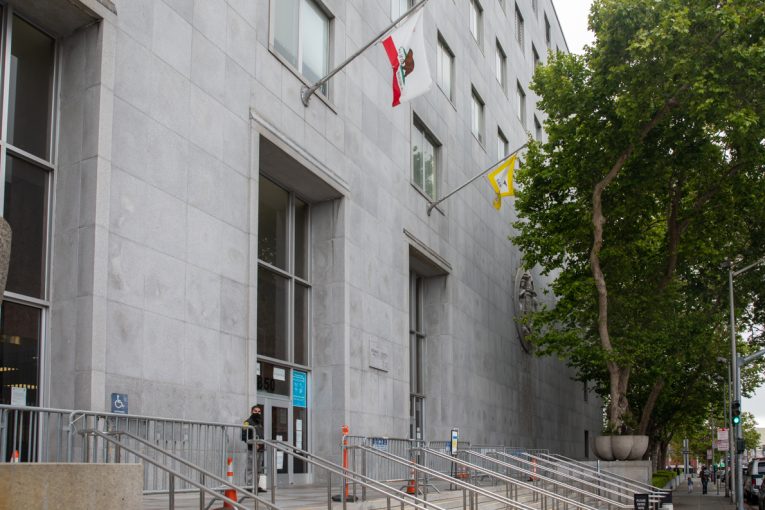
SAN FRANCISCO — A San Francisco judge imposed sanctions on prosecutors and barred them from using certain evidence during direct examination after discovering that key materials in a criminal case were disclosed years late, prompting renewed concerns about recurring discovery violations and their impact on defendants’ rights.
In a series of pretrial motion hearings in Department 503 at the Civic Center Courthouse, Public Defender Jared Rudolph argued before Judge Michael Begert that, because of late discovery within the case, there should be serious sanctions, or even a dismissal of the case against his client.
Rudolph filed a motion claiming that he received videos and materials from District Attorney Rachael McDaniels that should have been part of the original discovery in the case and, in fact, he did not receive them until the morning the attorneys were sent out to trial.
The case, which began in 2022, was set to begin trial Thursday, June 11, when Rudolph stated that he received an email the morning of the trial indicating there were additional materials to be turned over in discovery, including video of interviews with the alleged victim and body-worn camera footage of the officers during their initial investigation.
McDaniels stated that the District Attorney’s Office did not turn over this evidence earlier because it “was stored in an unusual location” and handed Rudolph a thumb drive with hours’ worth of video evidence on June 11, 2026, just hours before trial matters were set to be litigated.
Rudolph argued in court that these late discovery violations completely changed the landscape of the case and that, by not disclosing them earlier, the accused’s right to effective assistance of counsel was being violated.
Judge Begert found that there was good cause to grant the defense a continuance based on the late discovery and to take time to consider what sanctions and remedies would be appropriate for the situation.
On June 16, the parties again met in court, and Rudolph argued the defense’s motion to dismiss the case or find a remedy for the late discovery violation. Rudolph pointed out how late this discovery was and how unrealistic it was to expect the defense to be able to properly review and use the footage in the case.
Rudolph further discussed how the discovered videos, which include many discrepancies between the reports and transcripts that were previously given, would have changed how the entire case was handled from the beginning.
It is important, Rudolph said, for counsel and the accused to have all evidence available to them in a timely manner to prepare their case and evaluate whether a plea deal would be suitable given the situation. He stated that by not having this information available to him, the District Attorney was affecting Rudolph’s ability to advise his client and provide the right to effective assistance of counsel.
Rudolph described that a plea deal was offered earlier in the case’s proceedings, but the deal was turned down based on the facts at hand. However, new evidence introduced so late could change the defense’s mind about the offer.
Judge Begert addressed McDaniels and said that, given what Rudolph had just argued, the offer may have been turned down based on the missing evidence. “Would you be willing to make that offer again today?” he asked McDaniels.
McDaniels responded that the District Attorney’s Office “doesn’t make it a practice to reoffer deals that are turned down” and stated that it was not her intention to reopen the offer.
Begert responded, stating that “[the DA Office] generally don’t make it a practice to turn over evidence the day of the trial,” and that he did believe Rudolph’s motion held merit. Begert suggested that McDaniels call her supervisor and gave the court a brief recess to discuss the matter.
After the break, McDaniels stated that, after speaking with her supervisor, the office would be willing to reopen the offer to the defense.
In arguing his request for sanctions, Rudolph detailed how late discovery was a recurring problem with district attorneys and that McDaniels had also been involved in many prior late discovery violations. He stated how missing critical evidence had affected the strength of the case and prevented him from being able to use the videos during preliminary hearings to challenge discrepancies in officers’ reports.
Rudolph also cited how the courts have been reluctant to impose sanctions for this behavior. “If there’s no repercussions then they’re just going to keep doing it,” Rudolph stated, explaining that dismissal or a new preliminary hearing were necessary to prevent future violations.
“If every judge is going to shrug their shoulders and say ‘it happens,’ then it will keep happening,” Rudolph stated, expressing his concerns that the failure of courts to do anything about this behavior is what will allow it to continue happening.
Begert turned his attention to McDaniels and asked what she thought about potential sanctions and how this situation happened in the first place. “I can’t say why exactly that happened,” she said, but argued that the evidence wasn’t material enough to the defense to warrant any significant sanctions and suggested that a continuance would be suitable for the defense to have more time.
“[The] problem is they have to give up their right to a speedy trial,” Begert responded. “What if I excluded the video evidence?” he asked.
McDaniels retorted that she didn’t “think that would be in the interest of justice” and explained that, since the accused was out of custody, delays to the trial were much less of an inconvenience than if the accused were in jail and that a continuance was suitable.
Rudolph then highlighted how it was “alarming that the first thing they say is that they don’t know what happened,” and how it is an excuse that protects prosecutors from being found responsible for misconduct.
He also went on to discuss how exercising his client’s right to a speedy trial would be harmful at this point because he hadn’t had an opportunity to fully review all of the evidence. He described how the Public Defender’s Office has been overwhelmed with a high volume of cases, so hours’ worth of evidence suddenly appearing had a negative impact on his schedule.
Rudolph detailed that he had to spend hours at night after work reviewing these videos. “I can’t see how this can be fair if continued.”
After hearing arguments from both sides, Judge Begert decided to deny the motion for dismissal of the case. However, he declared that there would be sanctions, including very strict rules about how the late-discovery evidence could be used by the prosecution, and prevented the District Attorney from using it during direct examination.
The case is representative of a long-standing issue between the District Attorney’s Office and the Public Defender’s Office, with numerous cases in which district attorneys have turned over evidence extremely late in proceedings. In many of those cases, defense attorneys are disadvantaged, with little remedy or recourse for their clients.
In a brief interview, Rudolph stated that he has experienced late discovery multiple times during his career and even faced it in his last trial. “In my last trial, I received exonerating DNA evidence a year and half late.”
This evidence was especially impactful because his client was still in custody.
Rudolph describes each trial he handles as a “mini audit of the criminal justice system,” where it is the one time he is able to direct all of his attention to a single case. Unfortunately, he has seen essential evidence being withheld in his last two cases.
Rudolph talked about his concerns not just with the cases where late discovery is present, but also cases where evidence may not have been released at all.
“I worry about cases where my client has entered a plea because they were afraid to go to trial when there may be evidence that was withheld.”
