
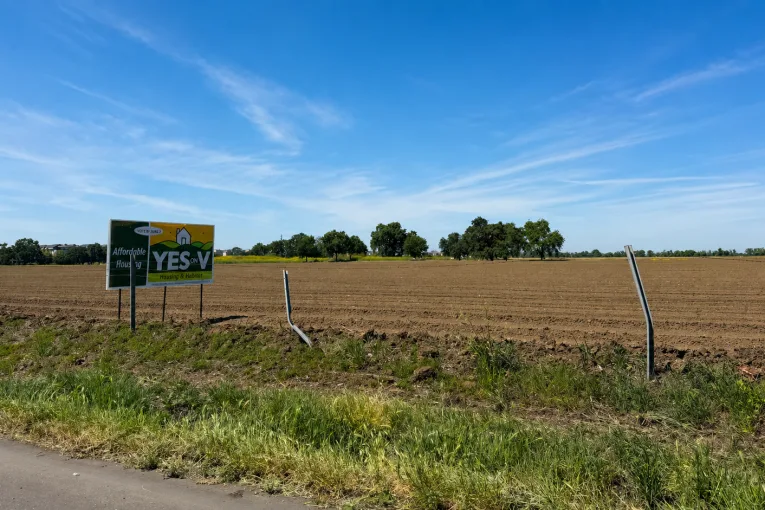
DAVIS, Calif. — There has been no concession from supporters and no formal declaration of victory from opponents, but as ballot counting nears completion, Measure V appears to have reached the end of the road.
According to the latest unofficial results released by Yolo County, Measure V trails by 270 votes, with 11,181 votes in favor and 11,451 opposed. The measure is receiving 49.40% support compared to 50.60% opposition.
According to county records, turnout reached 62.73%, with 23,368 ballots cast among 37,251 registered voters.
The margin narrowed slightly in the final rounds of counting.
Early returns showed the Village Farms proposal trailing by nearly 500, but supporters had hoped that late-arriving ballots would break more favorably toward the project.
The later counting results did swing towards the project but not enough to overcome the initial returns.
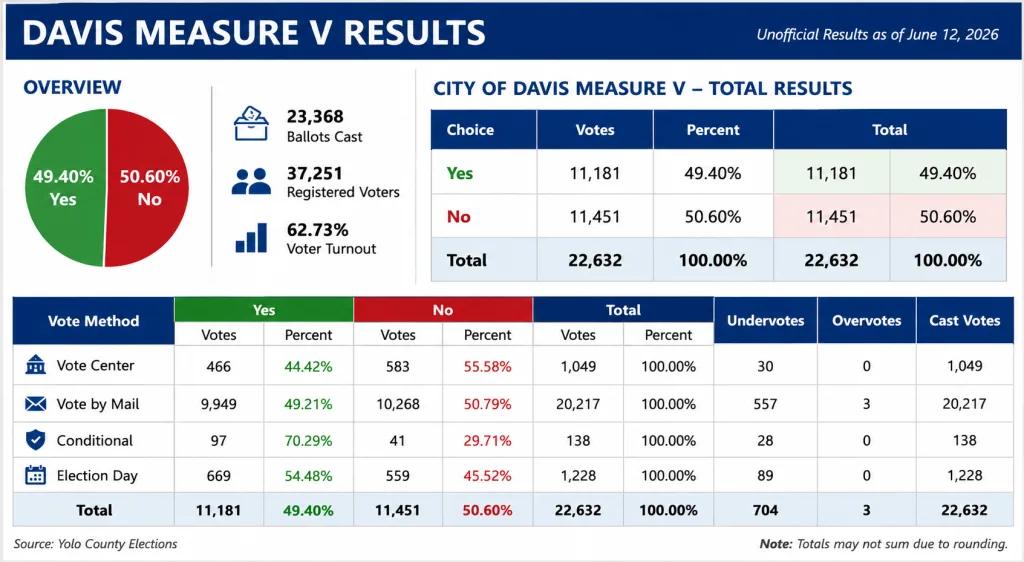
With only a small number of ballots remaining to be processed, the path to victory for Measure V appears all but exhausted. The current deficit represents roughly 1.2 percentage points, a gap that would require an unusually favorable split among the remaining ballots to overcome.
Measure V asked Davis voters whether to approve amendments to the city’s General Plan to allow the proposed Village Farms development north of Covell Boulevard.
The project would have authorized up to 1,800 housing units along with parks, open space and associated infrastructure improvements.
Because the site lies on agricultural land outside existing city limits, voter approval was required under Davis’ Measure J framework.
If the result holds, Measure V will become another defeat for a peripheral-growth housing proposal under Davis’ voter-approval system.
While several Measure J votes have failed over the years, the Village Farms election ranks among the closest. The narrow margin stands in contrast to some previous Measure J contests that were decided by much wider gaps including the 2005 Covell Village project on the same site that lost by a 60-40 margin.
The outcome is likely to intensify debate over housing policy in Davis including the future of Measure J itself.
Supporters argued the project would provide needed housing, including affordable units, help address declining school enrollment and expand the city’s tax base. Opponents contended the project posed environmental, infrastructure and fiscal concerns and questioned whether its benefits justified expansion onto agricultural land.
The defeat also comes as Davis continues to face pressure to meet state housing requirements and address long-term housing shortages. The Vanguard questioned whether Davis could meet its affordable housing needs without passage of the two peripheral projects on the ballot this year – with the council approving Willowgrove already for the November election.
Village Farms represented one of the largest housing proposals in the city’s history and was approved unanimously by the Davis City Council before being sent to voters earlier this year.
Follow the Vanguard on Social Media – X, Instagram and Facebook. Subscribe the Vanguard News letters. To make a tax-deductible donation, please visit davisvanguard.org/donate or give directly through ActBlue. Your support will ensure that the vital work of the Vanguard continues.

The very definition of insanity is doing the same thing over and over again, expecting different results.
We have a broken planning process. This was predictable. We did it anyway.
Why are we not fixing the broken process itself?
This is an example of measure J working as intended. The problem is not that voters have a veto, the problem is that our measure J process lets the developers do the planning, and that planning by definition is done according to the developer’s priorities (not necessarily ours as a city) So, strike one.
What is worse, measure J projects cannot by definition fit into any type of master plan… and the process itself effectively discourages any kind of master planning from happening. (why would you waste time making a plan for properties that might not get approved?). So there really isnt a path at the moment for us to have any “good” peripheral projects. They are self-contained, poorly connected, cant work with transit, cant plan for long-term services and city facilities… So Strike two.
Every measure J project gets on the ballot with at least two strikes against it. By definition.
THAT is the problem. Its time we fixed it.
The closeness of the result undermines arguments to weaken Measure J.
Unfortunately, it appears that the other proposal (Willowgrove) has more support (despite being in a worse location).
Perhaps if the Village Farms developers proposed something more similar to Willowgrove (and didn’t extend beyond the channel), it would have won. (Though I don’t know enough about the Willowgrove proposal to understand why it’s appealing to some.)
The first (and most-important) question that Measure J essentially asks is whether or not a given parcel should be developed at all. For some voters, the answer to that seems to depend upon the nature/details of a given proposal.
Disagree on your first point
Well, “good luck” on the effort to undermine Measure J. Not something that I feel particularly worried about – despite all of your articles regarding that topic.
The truly-determined growth monkeys (the “yes on everything crowd”) seemed to be aligned with some of the relatively slow-growthers regarding Willowgrove (at this point, at least). Which also doesn’t help “the cause” to undermine Measure J.
👿
The “Growth monkeys” Plus the “slow growhers” constitute a firm majority of voters.
Bring something that specifically meets the needs of those two constituencies and it WILL pass, especialy now that we have yet another confirmation that our broken process is indeed broken.
Tim: I think there’s still some division between those in your group (pushing for a city population that’s about double what it is now), vs. the slow-growthers such as Eileen (who aren’t pushing for that level of density).
Based on observation, I also think that Matt Williams is asking a similar question that will never be answered (e.g., a “community vision”).
The people engaged in “community visions” rarely represent the community.
Something like Measure J represents the community more than anything else. But it’s increasingly clear that proposals have, and will continue to be approved via that process.
Someone once mentioned that development patterns in cities usually concentrate density in the core; not at the outer edges of an expanding city. Which makes sense (and has always been true).
Your vision of high rises bordering Covell/Mace all the way out to the I-80 interchange (slight exaggeration) doesn’t seem to be a “community vision” to me.
Still (for what it’s worth) – I’ve gained some respect for your group (by rejecting Village Farms).
Ron, you are looking at Vision somewhat narrowly. Vision not only lays out a sense of where a community wants to go/be in its future, but also what the consequences are of that community direction.
At Thursday’s Science Cafe speaker Catherine Brinkley responded to one of my comments by saying that Davis’s slow growth efforts, including but not limited to Measure J, were a de facto Vision, even if the City’s General Plan does not have an actual Vision.
Regardless of whether Catherine is right or wrong about that, what is totally missing from the slow growth discussions is the fact that our current level of growth is not generating enough revenue to pay the bills the City incurs to deliver services and maintain our capital infrastructure.
Bottom-line, if no growth is indeed a Vision for Davis, then we need to increase revenues by increasing taxes. Otherwise our streets will continue to decay, as will all our capital infrastructure.
Matt: “Vision not only lays out a sense of where a community wants to go/be in its future, but also what the consequences are of that community direction.”
This kind of vote margin tells us that this community does not have a shared vision
Don, I agree with you wholeheartedly that Davis does not have a shared vision. How could we have that when our elected (and/or community) leaders have not fostered a community dialogue about Vision and the intended and unintended consequences of either that Vision or any alternative Visions.
Our elected leaders have taken the easy way out, and essentially kicked the can down the road to somebody else’s watch. And if that is all they had/have done that might have been okay, but in addition, when it served their personal interests they have unilaterally and authoritatively imposed their own sense of vision on their constituents … the gutting of the Village Farms Baseline Features and the imposition of the Cannery CFD being just two examples. Overriding the unanimous advice of the Planning Commission and the unanimous advice of the Utilities Commisdion on DWR being two others.
What is needed is a frank open community discussion of Vision and its consequences. It is long overdue. Until that happens Don is correct, we have no shared vision.
I would suggest that having a “shared vision” is asking too much if you take that term literally… none of us will all agree on everything.
But that is okay because the real question is:
“Is there a vision for our city that 50% of us +1 voter is willing to accept?” And I think that answer most definatley is yes.
Dr Brinkley is correct that measure J is something of a defacto vision… its “anti-sprawl” and that works… Its something that most davisites would agree on.
it doesnt have to be our perfect vision… it just needs to be acceptable enough to enough people to pass.
We have seen the issues that people support..
Its:
-preserving farmland,
-keeping traffic impacts to a minimum,
-Not bankrupting the city
-Supporting our schools
-Lots of subsidized affordable housing (that will actually get built)
-Inclusion of sufficient multifamily housing
Nerds like DCPG me want “transit-oriented”. but we are aware that most of the city doesnt yet realize how important that is
In any case, coming up with a master plan that optimizes along all of these things we have heard being said in the community isnt hard if you actually listen to what people say they want and try to craft something that adressess those concerns… they all just so happen to fit into the modern planning frameworks anyway… because a lot of these are well proven policy preferences for a reason, and they just work.
Shared Vision does not have to be polarizing. Start building that shared vision by defining the problem(s) that we face as a community and solicit opinions about their importance.
For example, one of the most important problems we face is that our streets are in serious disrepair and getting worse each year. How controversial is a shared vision that we ”live in a city where the municipal revenues are sufficient to maintain the streets … and those revenues are not redirected to other uses on a whim”
Similarly, how controversial is a shared vision that we ” live in a city where we consistently provide sufficient municipal revenues to pay for the services that we expect the city to provide.”
If we start with that two-pronged shared vision then we will have a fiscally sustainable and resilient foundation for considering other aspirational objectives for our future.
We don’t need to talk more. We just need to build some housing.
Don, housing by itself is a money loser for the City. That has been documented by over 10 independent fiscal studies done for and paid for by the City. Given the current declining state of Davis’ streets, bikeways, buildings and parks, do you really want to make that worse by building more housing without being honest with ourselves about our catastrophic fiscal condition?
A city is not intended to be a money-making enterprise. Cities are not businesses. If every city implemented your logic, no housing would be built anywhere, ever, because of the ongoing costs.
Here is what a city does:
“As a “general-purpose” city, Davis provides essential frontline municipal services. The City funds these activities through a variety of locally enacted revenues (parcel taxes, user and license fees, etc.) and with state-shared revenues (property tax, sales tax, and motor vehicle license fees).”
https://www.cityofdavis.org/about-davis/government
Prop 13 created a complete disconnect between city services and property taxes, and that has never been resolved. It is primarily staffing costs that cause city deficits.
By your definition, everything any city does is a “money loser for the city.”
Right now Measure J/R/D does not express a “vision”–it’s only a veto on what’s put before the voters. It’s more like “bring me a rock. Oh no, NOT that rock.” There’s no opportunity to give direction to project developers because the City has failed to get behind pushing on developers to deliver something that’s acceptable. But ultimately this goes back to the City Staff that’s guiding this process. They have consistently dismissed well informed and professional input from residents. City Staff holds the ultimate control through recommendations made to the Council. The Council is not composed of planning professionals so they can’t be well enough informed to be expected to counter what the City staff recommends. Instead of just letting the developers plunge ahead, the Staff needs to better understand what the voters are prepared to accept. Clearly they all missed the mark on Village Farms.
But the larger problem, as Tim alludes to, is the inability to coordinate projects so that we have a cohesive plan in a broader area, e.g., East Covell Specific Plan. Why wasn’t Village Farms, Willowgrove and Palomino Place coordinated? Instead they’re treated like they are on opposite ends of the country. This happens because Measure J/R/D effectively puts each of these in competition with each other rather than working for complementary synergies. Willowgrove and Village Farms didn’t want to be saddled with the other’s flaws that might take down both of them. This situation operates like the Prisoners’ Dilemma where the cooperative solution would be best but the risk of that option is too great for developers under the current veto scheme.
Instead we need a positive approach that tells developers ahead of time what we want rather than a negative approach that tells them what we don’t want afterwards. We need to consider how to give voters an opportunity to affirm that vision to replace the veto process that isn’t really working now. We’ll get many more viable, attractive proposals if we reverse our current process.
Don, just building more houses that look like Northstar won’t solve Davis’ problems in the long run. We need a better mix of the right kind of housing. You can see this in the difference in support for Village Farms vs Willowgrove. The rancor around the latter is much less than the former and much of that is because of the difference in housing mix.
“You can see this in the difference in support for Village Farms vs Willowgrove.”
The margin against Village Farms came almost entirely from the neighborhoods next door to the project site. Willowgrove has fewer neighbors to complain.
I would note that Village Farms appears to have lost by very few votes. If they felt like spending the money, the project team could make a few tweaks, put it on the next available ballot, and focus on turnout. Nothing about this election indicates a groundswell of interest in more planning, more discussions, more delays.
“Don, just building more houses that look like Northstar won’t solve Davis’ problems in the long run.”
I don’t expect a single housing project to “solve Davis problems.” I feel that we need BOTH Village Farms and Willowgrove. The difference is that I actually supported a real housing project, while opponents on here including yourself want to micromanage it (“a better mix of housing”) and insist that they accede to your demands.
Again: you guys find a landowner and builder willing to build the project you want, go for it. I would support that. I would also support another mobile home park, more duplexes and quadplexes, co-op housing, equity-limited housing, federally-funded housing, tiny homes, and even city-managed camping facilities, and if we get some McMansions along with all of that, well, there is definitely a market for them as well.
There seems to be a popular notion that we just need to get the community to agree on development preferences (we obviously won’t), turn those into requirements, and then hand them off to the developers and say “take it or leave it.”
So when the developers say “no thanks,” and head off to build housing elsewhere, what’s your plan? Because I think I can say with some confidence that there is not a long line of housing builders queueing up to work in this town.
“The rancor around the latter is much less than the former and much of that is because of the difference in housing mix.”
For some people, maybe. It’s also smaller and less-visible (and frankly, some might be afraid to oppose it at the moment).
I voted when Measure J was on the ballot the first, time, Covell Village was on the ballot, as well as Target. When I did so regarding the former, the “mix” of housing was not even on my radar (and it wasn’t even a ballot argument, as I recall). What mattered to me was conversion of farmland, the image of that lone tree (which passed-away shortly thereafter), etc.
I was shocked that 40% of voters actually supported it, at that time. Made me wonder if I’m actually smarter than some of the people whom I previously believed were smarter than me.
In fact, I would have rather had “rich” people move to Davis, than “poor” people.
Expensive shoeboxes aren’t appealing to “local workers” (whatever that means). Ask anyone in Spring Lake if they’re waiting for a developer to build them one in Davis, so that they can go through the incredibly-expensive process of selling, buying, and moving – to a smaller house no less. (If anyone actually does so, that would tell you far more about the reason that they “can’t afford Davis” than anything else.)
Don
I suggest reading Jim Frame’s comments that reveal much about what developers really want out of Measure J/R/D in terms of planning and zoning control. https://davisvanguard.org/2026/06/davis-measure-v-defeat/ Just leaving housing decisions to private developers with little public input is what got us into this mess. Maximizing profits and optimizing social benefits are not the same despite what free market proponents might try to claim.
Measure V came so close because of the faux school closure campaign the district ran and then called off on June 4. Look at the wide margin in West Davis where the district threatened to close Patwin (which doesn’t really make sense from a facilities management perspective.) Why didn’t the district make this decision in January? What changed? The timing is too suspicious.
Remember that DiSC II lost after DiSC I also came close. And Nishi II was radically changed from Nishii I to gain approval. The marginal voters who want a more resolute planning process are the key constituency in the success of these projects. And we’re not asking for much apparently as Willowgrove is offering 50% higher density with more missing middle market housing. It’s clearly profitable to do so. That would be the EIR Alternative 4 scaled down to south of Channel A. Village Farms did what it did due to focus on personal legacy for the prime mover.
Don, under California Law a City can not run a deficit Budget. Cities in California have to be at least “break even.”
Housing by itself is a money loser, but housing often doesn’t “travel alone.” One way to see the net effect of housing on a municipal jurisdiction is to compare the day time population to the night time population. In Palo Alto the day time population is more than 100,000 people greater than the night time population. In Davis the day time population is 20,000 to 25,000 people less than the night time population, with 21,000+ residents leaving Davis to go to their jobs, plus 10,000 to 15,000 students going to their classes, making a 31,000 to 36,000 outflow, offset partially by 12,000+ workers coming to their jobs located inside the City Limits. Bottom-line, Davis is a City with a housing/jobs imbalance.
Unlike Housing Alone, Housing that supports Jobs has a net positive focal effect on a City. Unfortunately, the majority of proposals that have come forward have been for housing only. Even when there is a jobs component, like Cannery came forward with, the jobs portion has been smoke and mirrors.
Ron O
“The first (and most-important) question that Measure J essentially asks is whether or not a given parcel should be developed at all. For some voters, the answer to that seems to depend upon the nature/details of a given proposal.”
This reveals the fatal flaw in Measure J/R/D. Because its treated only as a veto by voters and there’s no real path for public input, the public has no means of providing guidance on “the nature/details of a given proposal.” Seems like only a Davis expat living in Woodland really voices an objection to changing the rules to getting better outcomes for those of us who live in Davis.
Last time I checked, Richard – you weren’t exactly a representative of Davis any more than I am. (And allow me to express appreciation “on behalf of” the other residents of Davis in regard to that fact.)
Though (to give credit where it’s due), I do think that your little group’s arguments against Village Farms might have had some impact this time.
Another reason it’s going to be difficult to “blame the NIMBY’s” or Measure J itself (since your arguments don’t support that).
I recall pointing out something similar to Bill Marshal (R.I.P.). That is, it’s quite a hat trick to argue against Measure J if you use it to vote “no” on ANYTHING. (And if you doubt that, ask the council how they personally voted on every single Measure J proposal, and what they would do if “they” were in charge of such decisions.)
The elephant in the room regarding City finances is the policy that has already put over a billion dollars of student housing (highly fiscal positive housing for the City, County, and School District) on the UCD campus, with much more to come. That lost tax revenue explains the entire City budget gap. Whose idea was that anyway? I’m serious, whose idea was that? I somehow missed it…
Joe, where is there even one financial analysis that corroborates your assertion? Why does student rental housing produce either (1) greater revenues for the City than ownership housing? Or (2) lower services delivery costs for the City than ownership housing? Or (3) lower capital infrastructure repair/replacement/maintenance costs for the City than ownership housing?
I am all ears to hear your evidence.
Otherwise you are taking a page from Donald Trump’s playbook … assertions with no corroboration.
Hmmmm. So it was your idea? The burden is on advocates of a policy that on its face is such a fiscal disaster to demonstrate that despite all appearances, it is not such. So let’s see it Matt.
Joe, somewhere buried in that word salad of yours is a question. If I have tossed the salad correctly, tha answer to your question is that the City has done a financial analysis for every major housing development since 2000 and every one of them has been a money loser for the City. The reason that is the case is that (A) even if the project starts out with a positive Year One balance, the recurring revenues only grow between 2.0% and 2.5% per year, while the recurring costs grow at greater than 4% per year. That means for every project costs become greater than revenues. PLUS (B) none of the projects cover any of the costs of the end of useful life repair/replacement of the project’s capital infrastructure … streets, bikeways, buildings, parks and open space, traffic, and parking. Because of (B) thanks to the housing projects that have been built over the last 30 years, the City has amassed $264.7million of unfunded repair/replacement/maintenance costs, because they have no money to pay for those costs, and defer them (otherwise known as kicking the can down the road).
So, in poker parlance you made your bet, and I have seen your bet, matched it, called the hand, and spread my cards on the table. So, now is the time for you to show everyone what you’ve got.
“The reason that is the case is that (A) even if the project starts out with a positive Year One balance, the recurring revenues only grow between 2.0% and 2.5% per year, while the recurring costs grow at greater than 4% per year.”
The observation that costs rise faster than revenues, says absolutely nothing about the viability of housing. What it points to is the ongoing poor fiscal management of the City. In particular, the decades long failure to control increases in payroll and entitlement costs. Housing is not the loser here, poor management is.
“Housing is not the loser here, poor management is.”
To play the “devil’s advocate”, what if inflation is rising faster than the increase in property tax that Proposition 13 allows?
Do cities respond by only allowing raises that match property tax increases – rather than inflation?
Granted, Proposition 19 “fixed” some of this problem (but won’t have that much impact in Davis – since housing prices aren’t that expensive in the first place compared to other locales). As such, most of the housing can (still) be inherited by the heirs of an estate without increasing property tax liability.
Actually, some place like Davis is probably barely impacted by Proposition 19 for that reason – unless some house-rich buyers from the Bay Area move to Davis (the “carrot” part of Proposition 19). In which case, whomever/whatever receives those adjusted property taxes is the “loser”.
Mark, the housing creates the costs for (A) the services provided for the residents of the housing and (B) the capital infrastructure repair/replacement/maintenance of the infrastructure that would not exist if the housing were not there.
Regarding your poor management assertion, one of the first things they taught us at Wharton was to think like an income statement.. You are failing to follow that basic business advice by focusing on cost management by itself. Failure to manage costs is a legitimate criticism, but the inadequacy of revenues contributes just as much to the bad bottom line. Now at the risk of piling on regarding bad management, the reason for the inadequacy of the revenues is largely because the developers are better negotiators than our elected leaders and City staff are.
You can have bad management and still turn a profit, but if your business is consistently running in the red, that red ink reality is much more important and dealing with it is a much more urgent problem that whether management is good or bad.
Our current and long-standing reality is that housing loses money for municipal jurisdictions everywhere, not just in Davis. (See https://www.strongtowns.org/journal/2020-8-28-the-growth-ponzi-scheme-a-crash-course )
“Mark, the housing creates the costs for (A) the services provided for the residents of the housing and (B) the capital infrastructure repair/replacement/maintenance of the infrastructure that would not exist if the housing were not there.”
All of which should be accounted for by the impact fees. If the City is also incompetent in determining those fees…
More to the point, you treat all housing as the same. It is not. Multi-family and single family housing are not equivalent in terms of revenues or costs. Your argument fails yet again.
Mark, show me a fiscal study/analysis that shows your assertion to be true.
With that said, when the initial financial study for Nishi 2016 prepared by EPS came to the FBC … with its 2,000 high rise units and no single family detached housing, it didn’t ever get to break even in the early years of the recurring revenues, much less in the later years when the capital infrastructure begins to reach the end of useful life repair/replacement period. So, here too the City’s historical financial analyses do not support your assertion. Sterling is another example that doesn’t have more revenues than costs, as is Lincoln 40.
With that said, the only way that these housing only projects are going to achieve fiscal neutrality is by the City Council and City staff doing a better job of negotiating.
Unfortunately, the City has a long history of mishandling impact fees. They do not get used to cover the end of useful life repair/replacement costs when they come due in the future. Instead the cash brought in by those fees is used to cover current period expenses, and as a result, when those future costs come due they are deferred because there is no available cash to cover them. So they jack up our Unfunded Liabilities balance … which right now is $264.7 million and rising.
One of the challenges that City Council faces is that they can’t burden the new developments with not only their own repair/replacement costs, as well as the $264.7 million current balance. They have to come to the existing residents to cover that shortfall. That is a bit more than $3,700 for each of the 70,000 residents. How will you feel if you get a $3,700 bill from the City for each member of your household? Understandably Council is afraid of the backlash.
“Mark, show me a fiscal study/analysis that shows your assertion to be true.”
Sorry, Matt. You are the one that made the claim, so you are the one that needs to present the evidence, I’ll accept an independent study, not a biased report from City Staff trying to justify their ongoing mismanagement. The Terner Center would be a good place to start. Show me a report from them that supports your position that all housing is a losing proposition for all Cities. Without that, you are simply blowing hot air.
I will reach out to the Terner Center tomorrow.
With that said, what proportion of Davis housing do you estimate is multi-family?
Whatever that percentage is, the accumulated $264.7 million of unfunded capital infrastructure liability (a number that was not determined by City staff, but rather by an independent study, as you desire) has been contributed to by the whole of the city, not just by the single family residences.
The reason is simple, we have an abundant surplus of housing over and above jobs. Do we are deep into the “housing only” model. Look at all the housing that has been added to Davis in the last 30 years. Can you think of a single project that was planned to bring jobs to Davis, and have the companion housing provide living accommodations for the people filling those new jobs. The closest thing to that has been Mace Ranch. We are a bedroom community and I fully expect the Terner Center will agree with that assessment. Once upon a time we were a Uuniversity Town with housing growth following job growth at UCD, but that model stopped 25 years ago, and our inventory of Intellectual Capital Creation jobs filled by Davis residents is less than half of what it was 25 years ago.
So we are captives of the “housing only” development model.
Matt
It does make sense that more dense multi unit housing is much more likely to be a fiscal winner. The complaint is that UCD doesn’t compensate the City, but if that housing was in the City owned by private entities, they would paying property taxes plus business license revenue and any rentals fees. Analysis by planners such as Urban3 show that this type of housing is more fiscally self reliant. In addition, those students wouldn’t be relying on campus food services and instead would be shopping in city businesses generating more sales tax revenues. Other than the Urban3 studies and reports by Strongtowns I don’t have additional empirical evidence, but this perspective would be consistent with work along this line.
The defeat of Measure V appears to be overwhelmingly due to the precinct that comprises the neighborhoods directly adjacent to the project site.
margin — precinct — locations
1098 no — 15028 — Green Meadows — Mace Ranch — Lake Alhambra
338 no — 15027 — Old East Davis etc —
21 yes — 15026 — Northstar etc —
30 no — 15030 — South Davis — —
210 yes — 15013 — Central and old West Davis
839 yes — 15012 — West Davis — —
Total margin: 396 no
Don, given the Patwin School closing campaign slogan of DJUSD’s Board, is that a surprise?
I was tipped off to this from a post on the Facebook page of Davis Parents, the DJUSD Board:
On June 4, 2026, the Board directed staff to pause Boundaries and Planning discussions and related community engagement activities. No decisions have been made regarding school closures, school consolidation, or boundary changes. The Board will focus on budget priorities during the 2026–27 school year and may revisit planning discussions in Spring 2027 or later.
https://www.djusd.net/cms/one.aspx?portalId=117173&pageId=208535788
https://simbli.eboardsolutions.com/Meetings/Attachment.aspx?S=36030750&AID=1559116&MID=62012
The timing is suspicious. And I’m disappointed that the Vanguard did not pick up on this.
“The timing is suspicious. And I’m disappointed that the Vanguard did not pick up on this.”
Not entirely sure of your point here, but it seems to me that EVERYTHING those associated with the school district AND the Davis Vanguard is “suspicious” in regard to motivation related to development proposals.
Whatever your point is (and I think I have some general idea), I’m not “disappointed”, as I wouldn’t expect anything different at this point.
How naive are you exactly, to be “disappointed” regarding any of this?
The irony of Mace Ranch’s overwhelming opposition reveals a complete lack of historic meta-cognition about the history of the housing in which they live. It was opposition to Mace Ranch that started the no growth movement in Davis. Yet now the people who live in housing that was opposed by those who came before them preside over opposition to housing for those who come after.
In the long run, there is no “before and after” – since housing turns over (and has been turning over ever since Mace Ranch was built).
Anyone who claims they’re being “prevented” from living in Mace Ranch would also be “prevented” from purchasing in ANY housing development in an expanded Davis.
But it is true that a lot of people in Mace Ranch, Davis, and the region were priced out of their original hometowns due to civic pursuit of industries (such as the tech industry) that the original residents were not part of. (Maybe the “housing shortage people” should look into that, since it’s continuing to occur to this day.)
But yeah – please let me know if anyone claims they’re being prevented from moving to Mace Ranch, since I’m certain that I can find them a place within 30 seconds of searching on Zillow. I don’t even need to look in advance – that’s how confident I am that there’s housing available there (and in every other neighborhood in Davis) every single day.
We’ll see how those neighborhoods vote on Willowgrove which is even closer. I see one potential objection being the lights for the ballfield right on Covell across the street.
In reference to the fiscal argument for (some) types of growth, how are the actual “growth monkey/Ponzi scheme” cities in the region and state doing at this point? I used to track that – since there’s a website which shows this, but have lost interest.
But I am pretty sure that the wealthiest cities (most of which aren’t growing at all) are also more fiscally-sound than average. Is Atherton or Tiburon having trouble paying for street sweeping, etc. – at this point? Are they looking for “new residents” to pay for it, instead?
Or if you want to move it “down” a notch, is some place like Huntington Beach clamoring for growth for the same reason?
How is Santa Barbara faring these days, regarding city finances and services?
And how is Stockton doing (they’ve always embraced sprawl).