
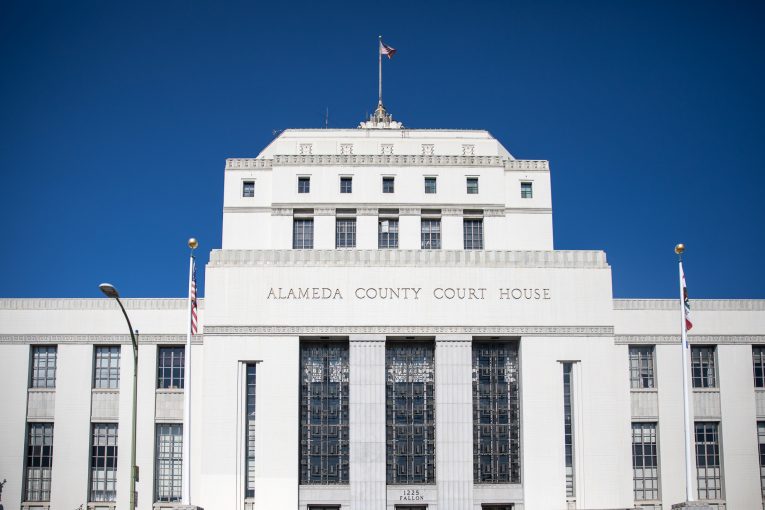
ALAMEDA, Calif. — Two formerly death-sentenced Californians have sued the Alameda County District Attorney’s Office, alleging prosecutors systematically excluded Black and Jewish jurors from their capital trials in the 1990s, after a federal judge found a pattern of unconstitutional prosecutorial misconduct that led to their death sentences being reduced, according to the Death Penalty Information Center.
Ernest Dykes and Curtis Ervin sued the Alameda County District Attorney’s Office, alleging it “set out to rig the juries” in their capital cases during the 1990s, according to the Death Penalty Information Center.
In 2024, U.S. District Judge Vince Chhabria found a pattern of unconstitutional prosecutorial misconduct, leading to both of their death sentences being reduced. The lawsuit alleges the Alameda County District Attorney’s Office knowingly participated in racial discrimination during jury selection.
According to the suit, the evidence proves the errors were the product of a “pattern and practice reinforced by those with supervisory authority.” Both lawsuits state that the Alameda County District Attorney’s Office intentionally removed Jewish and Black jurors from participating in their trials and seek financial compensation for the pain and suffering they endured during their incarceration, as well as punitive damages.
Following these findings, then-Alameda County District Attorney Pamela Price agreed to conduct a lengthy review of all capital cases processed during that period, according to the article. After Judge Chhabria’s ruling, Price confirmed her office had a historical practice of excluding Black and Jewish jurors. She stated the people of Alameda County “did not receive a fair trial,” and that the evidence pointed to a variety of prosecutors exhibiting such bias rather than just one or two.
A statement from Brian Pomerantz, the attorney representing both Dykes and Ervin, highlights how the two men not only lost decades of their lives but also how their cases demonstrate a broader threat to the community. Pomerantz stated that “all the people living in Alameda County [are] threatened by a DA’s office that thinks this … discrimination is okay.”
According to the article, evidence uncovered in Dykes’ case revealed index cards from Alameda County prosecutors showing the systematic exclusion of jurors based on race and religion. One index card described a prospective Black female juror as “short, fat, trolls,” while other notes stated that prosecutors did not believe another Black female juror. Similar patterns were found involving prospective Jewish jurors, with one note stating a juror was “…better than any other Jew, but no way.”
The article states that Dykes pleaded guilty to his crimes and spent more than 30 years on death row before being resentenced in late 2024 and released one year later because of the misconduct found in his jury selection.
His lawsuit states that even if Dykes had been convicted of the lesser charges on which he was resentenced in 2024, he would have been released from prison in August 2009 and never would have been placed on death row. This means Dykes’ incarceration lasted at least 15 years longer than it should have.
According to the article, Dykes is seeking damages for the suffering he endured during the “years of incarceration which deprived him of his freedom… access to family, and loved ones,” as well as confinement to a small cell for at least 20 hours a day, which weighed on his mental and physical health.
According to the Death Penalty Information Center, Dykes has asked the court to order Alameda County to compensate him $32 million for the harms he suffered, as well as $250 million in punitive damages.
According to the Death Penalty Information Center, during Ervin’s jury selection, three Black men and six Black women were struck from the jury pool, leaving just one Black man on the jury and one Black man as an alternate. Ervin’s lawsuit highlights that “every Black woman who made it to the jury box was excused.” The article states the suit also notes that the trial prosecutors “used religion as pretext to justify his race-based peremptory challenges.”
According to the article, Ervin, who has long maintained his innocence, spent 33 years on death row before the Alameda County District Attorney’s Office conceded that trial prosecutors engaged in unconstitutional discrimination during jury selection. In August 2024, he was resentenced on lesser charges. After nearly 39 years in prison, he was released in August 2025.
According to his lawsuit, “[b]ut for the [Alameda] County’s unconstitutional conduct, Mr. Ervin would have been released from prison on May 18, 2000, and would have never been on death row.” This means “Mr. Ervin was incarcerated for 25 years, 3 months, and 7 days longer than he should have been.”
The article states that, like Dykes, Ervin seeks compensation for the distress he endured while incarcerated. Ervin has requested that the court order Alameda County to pay him $40 million for the suffering he experienced, along with an additional $250 million in punitive damages.
The Death Penalty Information Center writes that these cases illustrate a seldom-discussed financial cost of the death penalty. While compensation claims are typically linked to exonerations, neither Dykes nor Ervin has been exonerated. Instead, both men argue that unconstitutional discrimination during jury selection resulted in decades of wrongful imprisonment beyond the sentences they otherwise would have served.
According to the article, both lawsuits allege it was a standard, unwritten practice in the Alameda County District Attorney’s Office between 1980 and 2012 to intentionally exclude Black and Jewish jurors from capital juries.
It states that “[t]he ACDAO’s history of discriminatory and unconstitutional conduct, dispensed by design through deliberate mistraining of its employees, particularly in capital cases involving special circumstances prosecutions, is clear from a review of its cases,” each lawsuit states.
According to the article, “ACDAO prosecutors determined that Black and Jewish jurors were unfavorable to them and set out to eliminate members of those two race/ethnicities from their juries. Thus, the ACDAO routinely and as a matter of office-wide practice, used peremptory strikes to eliminate Black and Jewish jurors from service based on their race and/or ethnicity,” the suits state.
According to the Death Penalty Information Center, the last person executed in California was Clarence Ray Allen in 2006. Two decades later, the population on California’s death row has fallen to fewer than 580 incarcerated people, down from a peak of nearly 750 in the mid-2010s.
The article states that, since Allen’s execution, California’s death penalty has faced increasing scrutiny because of concerns over racial discrimination, wrongful convictions and the financial costs of capital punishment.
The article concludes that in 2019, Gov. Gavin Newsom imposed a moratorium on executions, leading to a shift of death-sentenced incarcerated people into less restrictive conditions within the general prison population. Advocates have also called on the governor to consider granting mass clemency.
Follow the Vanguard on Social Media – X, Instagram and Facebook. Subscribe the Vanguard News letters. To make a tax-deductible donation, please visit davisvanguard.org/donate or give directly through ActBlue. Your support will ensure that the vital work of the Vanguard continues.
